The construction industry isn’t exactly known for moving fast.
For decades, most job sites looked pretty much the same — clipboards, paper blueprints, endless phone calls, and workers trying to solve problems in real time.
But 2026?
That’s a completely different story.
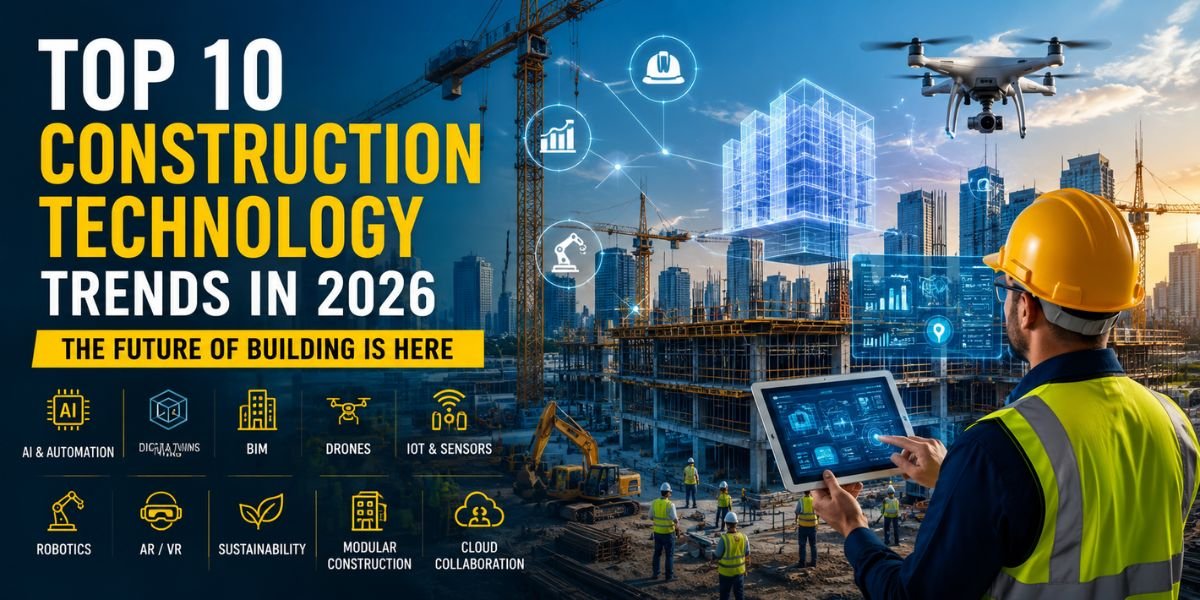
Today, construction companies are using artificial intelligence, digital twins, robotics, and smart sensors to build projects faster, safer, and more efficiently than ever before. What once sounded like science fiction is now showing up on real construction sites around the world.
And honestly? The pace of innovation is getting a little wild.
Whether you’re a contractor, engineer, architect, project manager, or simply curious about where the industry is heading, these are the construction technology trends that are shaping the future right now.
Let’s dive in.
1. Artificial Intelligence Is Becoming the New Project Assistant
A few years ago, AI was mostly a buzzword.
Now it’s helping construction teams make smarter decisions every single day.
AI-powered software can analyze project schedules, budgets, labor requirements, and risk factors within seconds. Instead of relying purely on human predictions, project managers can identify potential delays before they happen.
Imagine knowing a project is likely to fall behind schedule three weeks before anyone on-site notices.
That’s the power of AI.
Construction companies are also using AI to optimize workflows, improve safety monitoring, and reduce waste. As machine learning systems continue to improve, expect AI to become a standard tool across the industry.
2. Digital Twins Are Revolutionizing Project Planning
If you’ve never heard of a digital twin, don’t worry.
A digital twin is essentially a virtual replica of a building, bridge, road, or infrastructure project.
Think of it as a living, breathing digital version of a physical asset.
Engineers can monitor performance, test changes, and identify maintenance needs without touching the actual structure.
The technology is becoming incredibly valuable for large-scale infrastructure projects because it helps teams spot problems before they become expensive disasters.
Many experts believe digital twins will soon become as common as CAD software once was.
For a deeper look at how digital engineering is transforming infrastructure projects, check out our internal guide on Digital Engineering and Modern Construction Workflows.
3. BIM Continues to Dominate Construction Projects
Building Information Modeling (BIM) isn’t exactly new.
But in 2026, it’s more important than ever.
BIM allows architects, engineers, contractors, and project owners to collaborate using a shared digital model.
Instead of juggling dozens of separate documents, everyone works from the same source of truth.
This dramatically reduces communication errors, design conflicts, and costly rework.
As construction projects become increasingly complex, BIM remains one of the most powerful technologies available for improving coordination and efficiency.
Many organizations now consider BIM an essential requirement rather than an optional tool.
4. Robotics Are Taking Over Repetitive Tasks
No, robots aren’t replacing construction workers tomorrow.
But they are making life easier.
Construction robots are increasingly handling repetitive and labor-intensive tasks such as bricklaying, concrete finishing, material transportation, and site inspections.
These machines can work longer hours, improve consistency, and reduce worker fatigue.
The labor shortage affecting many regions has also accelerated robotics adoption.
Rather than replacing workers, robots are helping skilled professionals focus on higher-value activities that require human expertise.
And let’s be honest — nobody dreams of spending eight hours doing the same repetitive task over and over again.
5. Drones Have Become Standard Equipment
Remember when drones felt like expensive toys?
Not anymore.
Today’s construction sites rely heavily on drones for surveying, mapping, inspections, and progress tracking.
A task that once required days of manual measurement can now be completed in a matter of hours.
Drones provide accurate aerial imagery, improve safety, and give project managers real-time visibility into site conditions.
They’re particularly useful for large infrastructure and commercial construction projects where monitoring progress from the ground can be challenging.
The best part?
Drone technology keeps getting cheaper and more capable every year.
6. Smart Wearables Are Improving Worker Safety
Construction remains one of the world’s most dangerous industries.
That’s why wearable technology is becoming such a big deal.
Smart helmets, connected safety vests, biometric sensors, and location-tracking devices help monitor worker conditions in real time.
If a worker experiences fatigue, heat stress, or enters a hazardous area, supervisors can receive immediate alerts.
These technologies don’t just improve safety statistics.
They save lives.
As regulations become stricter and companies prioritize worker well-being, wearable technology adoption is expected to continue growing rapidly.
7. Sustainable Construction Technology Is Everywhere
Green construction is no longer a niche trend.
It’s becoming an industry standard.
Governments, developers, and property owners are demanding more sustainable buildings with lower environmental impact.
As a result, construction firms are embracing technologies that improve energy efficiency and reduce waste.
Some of the biggest innovations include:
- Smart energy management systems
- Low-carbon construction materials
- Advanced insulation technologies
- Solar-integrated building systems
- Water conservation solutions
According to the U.S. Green Building Council, sustainable building practices continue to play a major role in reducing operational costs and environmental impact across the construction sector.
8. Augmented Reality Is Changing Job Sites
Imagine putting on a headset and seeing an entire building before it’s constructed.
That’s exactly what augmented reality (AR) allows.
AR overlays digital information onto real-world environments, helping construction professionals visualize designs directly on-site.
This makes it easier to identify design issues, coordinate installations, and communicate project plans.
Instead of interpreting complex drawings, workers can literally see where components should be placed.
The result?
Fewer mistakes, better collaboration, and faster decision-making.
Not bad for something that sounded like a video game feature just a few years ago.
9. Modular and Prefabricated Construction Is Growing Fast
Traditional construction methods can be slow.
Very slow.
That’s why modular construction is gaining momentum worldwide.
Rather than building everything on-site, components are manufactured in controlled factory environments and assembled at the project location.
This approach offers several advantages:
- Faster project completion
- Improved quality control
- Reduced material waste
- Lower labor requirements
- Better schedule predictability
As demand for housing and infrastructure continues to rise, modular construction provides an attractive solution for accelerating project delivery.
10. Connected Construction Through IoT
The Internet of Things (IoT) is quietly transforming construction operations.
Sensors embedded throughout equipment, vehicles, and buildings collect valuable data around the clock.
Project teams can monitor equipment performance, track material usage, analyze site conditions, and improve maintenance planning.
Instead of reacting to problems after they occur, companies can proactively address issues before they impact productivity.
IoT technology also works exceptionally well alongside BIM, AI, and digital twin platforms, creating a highly connected construction ecosystem.
The future isn’t just digital.
It’s connected.
What These Trends Mean for the Future
If there’s one thing that’s clear, it’s this:
Construction technology is no longer optional.
The companies embracing innovation are gaining significant advantages in productivity, safety, project delivery, and profitability.
Meanwhile, businesses that resist change may find themselves struggling to compete in an increasingly digital industry.
The good news is that many of these technologies are becoming more affordable and accessible than ever before.
Whether it’s BIM, AI, drones, digital twins, or wearable devices, construction professionals now have tools that previous generations could only dream about.
Final Thoughts
The construction industry is experiencing one of the biggest technological transformations in its history.
From artificial intelligence and digital twins to robotics and connected job sites, the innovations emerging in 2026 are reshaping how projects are designed, managed, and delivered.
While not every company will adopt every technology immediately, one thing is certain:
The future of construction belongs to organizations willing to innovate.
And based on the speed of change we’re seeing today, the next few years are going to be incredibly exciting.