You’re standing in your living room, looking at those tired beige walls, and you finally decide it’s time. Time for a fresh coat of paint. A new color. A new feel.
Then comes the question that stops everyone: What is this actually going to cost?
I’ve been through this dance multiple times—getting quotes, comparing DIY numbers, and even helping friends negotiate with contractors. And here’s the truth: most online calculators are useless because they confuse floor space with wall space.
A 1,500 square foot house is a very common size. That’s typically a three-bedroom, two-bathroom ranch or a two-story colonial with a small footprint. Let me give you real numbers for 2026, broken down so you actually understand where every dollar goes.
Note: All prices are national averages. If you live in Manhattan or San Francisco, expect to pay 30–50% more. If you’re in rural Mississippi or Ohio, you might pay 15–20% less.
Breaking Down the Total Cost: What Will You Actually Pay?
First, forget the floor space for a minute. Painters don’t walk into your house and say, “You have 1,500 square feet of floor, so here’s the price.” They measure your walls, ceilings, trim, and doors.
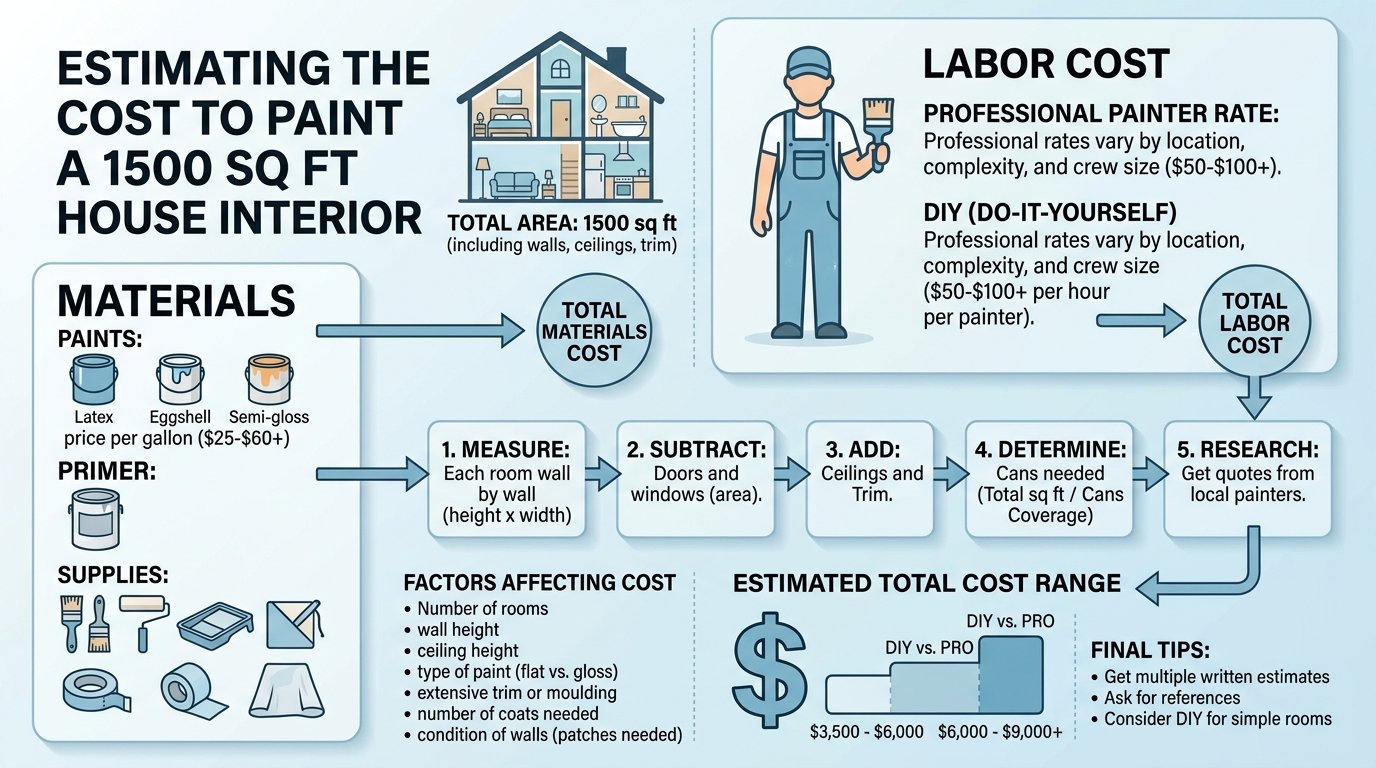
For a 1,500 square foot house with 8-foot ceilings, you actually have roughly 4,500 to 5,000 square feet of paintable surface area. That’s the real number that matters.
Here are the total national average ranges for 2026:
- Low End (Basic Paint, Minimal Prep, One Color): 3,000–4,500
- Mid-Range (Good Quality Paint, Two Coats, Basic Trim): 4,500–6,500
- High End (Premium Paint, Multiple Colors, Full Trim & Ceilings): 6,500–9,000+
Why such a wide range? I’ll break that down next. But if someone quotes you $2,000 for a full 1,500 square foot house, run. They’re either skipping prep work or using garbage paint that will peel in a year.
Why Do I Smell Sewage in My House? 7 Common Causes & Quick Fixes
The Cost Breakdown: Where Does Your Money Go?
Let me pull back the curtain on how painting contractors build their estimates. This knowledge alone will save you from being overcharged.
Labor Costs (The Biggest Slice – 70% to 85%)
Here’s what most homeowners don’t realize: you aren’t paying for paint. You’re paying for people.
A professional painting crew typically charges 2to6 per square foot of floor space for a full interior. For 1,500 square feet, that’s 3,000to9,000, which matches our range above.
Why is labor so expensive? Because you’re paying for:
- Speed: A team of two or three pros will finish your whole house in two to four days.
- Expertise: Clean edges, no drips, proper rolling technique, and they know exactly how to cut in around windows without tape.
- Insurance: If they fall off a ladder or spill paint on your hardwood floor, their insurance covers it. Your homeowner’s insurance does not.
- The grunt work: Moving furniture, covering floors, patching holes, sanding, caulking, and cleaning up every speck of dust.
I watched a friend try to DIY his 1,500 square foot house. It took him three weekends just to do the living room and master bedroom. He quit after that and hired a crew. The crew finished the rest in two days.
Paint & Material Costs (The Remaining 15% to 30%)
This is the part you can actually calculate yourself.
How many gallons do you need?
For a 1,500 square foot house with standard 8-foot ceilings, plan on 10 to 15 gallons of paint for two coats on the walls. If you’re also painting ceilings and trim, add another 3 to 5 gallons.
What does paint cost?
- Budget paint (Glidden, Behr entry-level): 20–35 per gallon. Two stars. You’ll need extra coats.
- Mid-range paint (Sherwin-Williams SuperPaint, Behr Premium Plus): 40–55 per gallon. Four stars. What most contractors use.
- Premium paint (Benjamin Moore Regal, Sherwin-Williams Duration): 60–80 per gallon. Five stars. Better coverage, washable, lasts longer.
For a full house, your paint bill alone will be 400to1,200 depending on quality.
Don’t forget supplies:
Add 200to300 for brushes, roller covers, trays, painter’s tape (the good purple stuff), plastic sheeting, and drop cloths. Cheap supplies make a cheap finish.
Preparation and Drywall Repair (The Hidden Cost)
Here’s where estimates really start to diverge.
If your walls are in good shape—no major cracks, no water stains, no holes—prep work is minimal. Maybe a light sanding and some spot priming.
But if your house has seen better days? Those nail pops, settling cracks, and mysterious dings from moving furniture all need fixing before a drop of paint touches the wall.
Expect to pay an extra 500to1,500 for significant drywall repair. Some contractors bundle this into their quote. Others list it as a separate line item. Ask before you sign anything.
DIY vs. Hiring a Professional Painter: Which Is Cheaper?
Let me give you the honest, no-spin comparison.
The DIY Total Cost (Materials Only)
- Paint (12 gallons at 40/gal):480
- Primer (3 gallons): $90
- Brushes, rollers, trays, tape: $150
- Drop cloths and plastic sheeting: $80
- Ladder rental (if needed): $50
- Total DIY cost: Approximately 850to850to1,500
That sounds great, right? But here’s the catch.
The time investment: Expect 80 to 120 hours of work. That’s 10 to 15 full days. For most people, that means painting every weekend for two months. Your living room will be a disaster zone for weeks.
The physical toll: Your shoulders will ache. Your neck will hurt from looking up at ceilings. You’ll get paint in your hair. Ask me how I know.
The quality risk: Pro painters get clean lines because they’ve done it ten thousand times. Your first attempt will have roller lines, uneven coverage, and paint on the trim. And moving all that furniture yourself? Have fun.
The Professional Total Cost
- Total cost: 3,000to3,000to9,000
The time: They’re done in two to four days. You come home to a clean, dry, perfect house.
The value: They patch holes you didn’t even notice. They caulk gaps. They paint the ceiling edges without getting a single drop on the wall.
The ROI: If you’re selling your home, professional painting has an average return on investment of 107%. A sloppy DIY paint job actually lowers your home’s value. Buyers notice bad edges and roller stipple immediately.
My advice: Paint one room yourself. If you enjoy it and you’re good at it, do the whole house. If you hate it or it looks bad after one room, hire a pro. There’s no shame in that.
Room-by-Room Cost Guide for a 1,500 Sq Ft Home
Let me give you ballpark numbers for specific spaces. These assume mid-range paint and standard prep.
Living Room / Family Room
600–600–1,000
This is usually the largest room. If you have vaulted ceilings or a two-story great room, add 200to400 for the extra ladder work.
Kitchen
400–400–700
Less wall space because of cabinets, but more cutting-in work around the cabinets, windows, and backsplash. Breakfast nooks are usually included here.
Master Bedroom
400–400–800
Master bedrooms are often larger than guest rooms. If you have a tray ceiling or accent wall, add 100to150.
Guest Bedroom (Standard 10×12)
300–300–500
Simple box rooms with one window and a closet are the cheapest to paint.
Bathrooms
200–200–500 per bathroom
Small spaces, but they require more precise cutting-in around vanities, mirrors, and toilets. Also, bathrooms need moisture-resistant paint (satin or semi-gloss), which costs slightly more.
Hallways & Stairwells
300–300–700
Hallways are narrow and tedious. Stairwells require ladders or scaffolding. This is one area where DIY is particularly miserable.
5 Hidden Factors That Increase Your Painting Estimate
Contractors don’t always mention these up front. I will.
1. Ceiling Height
Standard 8-foot ceilings are cheap. Every painter has a roller pole for that.
But 10-foot or vaulted ceilings? That requires extension ladders, scaffolding, or a rolling scaffold tower. Add 20% to 40% to the labor cost for the safety equipment and the slower pace.
2. Dramatic Color Changes
Switching from off-white to light gray? Easy. Two coats, done.
Switching from dark navy blue to light beige? That requires primer, then two coats, sometimes three. Dark red to white is even worse. If you’re making a dramatic change, expect to pay for extra materials and time.
3. Trim and Doors
Painting just the walls is one price. Painting walls, baseboards, window casings, door frames, and doors is another.
Trim work is slow and detail-oriented. A full interior paint job with high-quality trim painting can easily add 1,500to2,500 to your quote.
4. Wall Texture
Smooth walls take paint efficiently. Knockdown texture, orange peel, or popcorn ceilings? They act like sponges. The paint soaks into the crevices, requiring up to 30% more paint than smooth walls.
5. Location, Location, Location
A painting crew in Dallas or Atlanta might charge 3,500fora1,500squarefoothouse.ThatsamejobinBostonorSeattlecouldbe6,500. In Manhattan or San Francisco? 8,000to10,000 easily.
The difference is labor rates, cost of living, and demand. Get local quotes.
Frequently Asked Questions
How many gallons of paint do I need for a 1500 sq ft house?
For the walls only, with two coats, you need 10 to 15 gallons. To calculate it yourself: measure the perimeter of each room, multiply by ceiling height, subtract doors and windows, then divide by 350 (the coverage per gallon). If you’re also painting ceilings and trim, add 3 to 5 more gallons.
Does the cost of paint include the primer?
Typically no. Most contractors price primer separately, especially if the walls are new drywall, have water stains, or are undergoing a dramatic color change. If your walls are already painted a similar color, you might not need primer at all. Ask specifically: “Is primer included or separate?”
Is it worth painting a house before selling?
Yes. Paint is the single highest-ROI home improvement project. According to Remodeling Magazine’s Cost vs. Value report, interior painting returns over 100% of its cost at resale. A fresh, neutral paint job makes the house look clean and move-in ready. Just don’t pick bold colors. Stick to agreeable gray, accessible beige, or alabaster white.
Why do painters charge by the square foot of the floor?
It’s an industry shortcut. A 10×10 room takes roughly the same amount of prep, taping, and cleanup whether you paint it blue or white. The floor square footage gives a rough proxy for the total work involved. Reputable contractors will do a detailed walkthrough and measure wall area, but many will still quote you based on floor square footage.
Can I negotiate with a painting contractor?
You can ask. The most successful negotiation tactic is bundling: “What if I hire you to do the interior and the exterior at the same time?” Contractors love filling their schedule with larger jobs and will often discount 10–15%. Asking for a discount on a single interior room probably won’t work. Also, paying in cash sometimes helps, but that’s between you and the contractor.
How much should I budget for a 1500 sq ft house in a high-cost city?
If you’re in New York, Los Angeles, San Francisco, Boston, or Seattle, adjust the national average upward by 30% to 50%. A 5,000jobinAtlantamightbe7,500 in Los Angeles. Get three local quotes. If they’re all high, that’s just the market rate.
Final Thoughts: How to Get the Best Price
After getting quotes for my own house and helping friends with theirs, I’ve learned a few tricks that actually work.
Get three written estimates. Never accept a verbal quote over the phone. A written estimate protects both of you.
Be specific in your request. Don’t just say “paint my house.” Say “paint living room, kitchen, three bedrooms, two bathrooms, and hallway. Two coats of Sherwin-Williams SuperPaint in Agreeable Gray. Eggshell on walls, semi-gloss on trim. Move furniture back into place.”
Ask about prep work. A low bid almost always means they’re skipping sanding, spackling, and caulking. You don’t want that.
Do the prep yourself. If you want to save money, move your own furniture, take down curtains, remove switch plate covers, and patch small nail holes. Let the pros do the painting. This can knock 300to500 off the quote.
Time it right. Painting contractors are busiest in spring and summer. If you can schedule for January or February, you might get a 10% discount because they need the work.
One last piece of advice: Don’t buy the cheapest paint. I’ve seen 25paintneedthreecoatstocover,while55 paint covers perfectly in two coats. The math is simple: 10 gallons of cheap paint at 25is250. Ten gallons of good paint at 55is550. But if the cheap paint needs three gallons extra to actually cover, the price gap shrinks fast. Pay for quality.