When people search for the biggest house in the world, they often expect one simple answer. But the answer depends on what you mean by “biggest.”
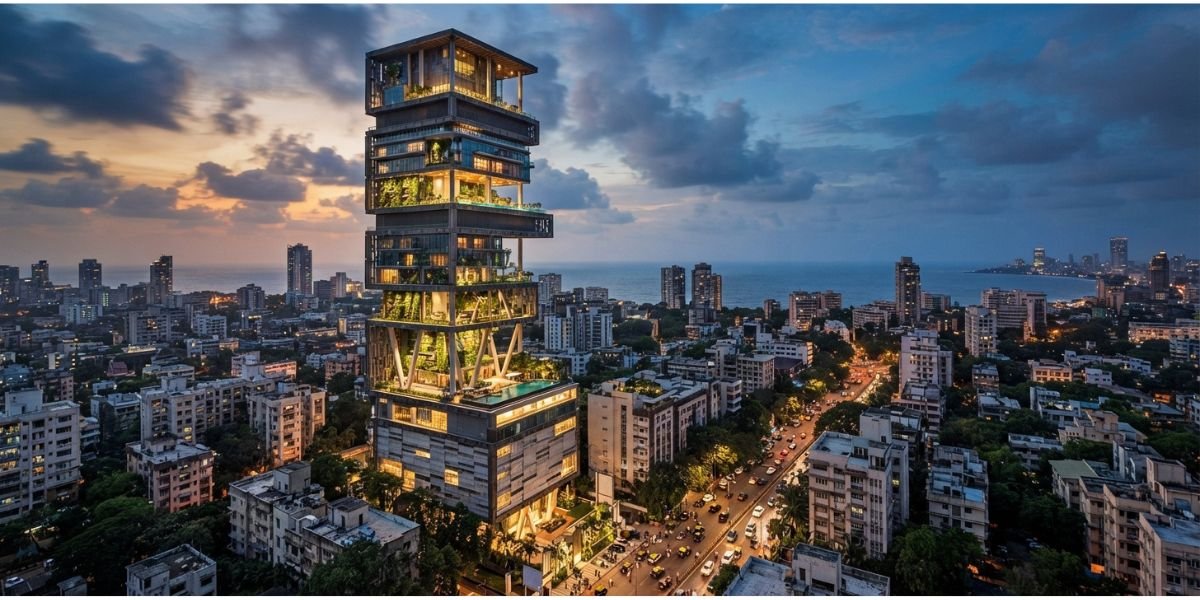
If we are talking about the largest private house, the answer is Antilia, the extraordinary 27-storey residence of Indian businessman Mukesh Ambani in Mumbai. Guinness World Records currently lists Antilia as the largest house, with a total living floor area of about 37,000 square metres (400,000 square feet).
But if royal residences and palaces are included, the picture changes dramatically. Istana Nurul Iman, the official residence of the Sultan of Brunei, holds the Guinness World Records title for the largest residential palace, covering approximately 200,000 square metres (2.15 million square feet).
These extraordinary properties show just how far residential architecture can go when designers are given enormous budgets, huge sites and almost no ordinary limitations.
In this guide, we’ll look at the world’s biggest residential properties, how they compare, what makes them so unusual, and why Antilia remains one of the most remarkable private homes ever built.
What Is the Biggest House in the World?
The answer depends on the category.
For a private house owned by an individual, Guinness World Records identifies Antilia in Mumbai, India, as the largest house. It has approximately 37,000 square metres (400,000 square feet) of living floor area and rises 173 metres (568 feet) above Mumbai.
For a residential palace, the record belongs to Istana Nurul Iman in Brunei, which covers approximately 200,000 square metres (2,152,782 square feet). It contains 1,788 rooms and 257 bathrooms.
That distinction matters because a palace is not necessarily comparable to a privately owned family residence. A palace can serve official, ceremonial and governmental functions in addition to being a residence.
Biggest Residential Properties at a Glance
| Property | Location | Approx. Size | Category |
|---|---|---|---|
| Antilia | Mumbai, India | 400,000 sq ft | Largest private house |
| Istana Nurul Iman | Brunei | 2.15 million sq ft | Largest residential palace |
| Buckingham Palace | London, UK | 828,000+ sq ft | Royal residence |
| Witanhurst | London, UK | 90,000 sq ft | Large private residence |
| Villa Leopolda | French Riviera | 80,000 sq ft | Historic private residence |
The figures above should not be treated as a single universal ranking because the properties differ in ownership, purpose and how their areas are measured.
Antilia: The World’s Biggest Private House
Antilia is located on Altamount Road in South Mumbai, one of India’s most expensive residential areas. Rather than spreading across a huge horizontal estate, the residence rises vertically above the city.
That vertical approach is one of the most interesting aspects of its architecture.
Antilia has 27 storeys and stands approximately 173 metres (568 feet) tall. Because many of its floors have unusually high ceilings, Guinness notes that its height is comparable to that of a typical 60-storey office building.
The property occupies a plot of approximately 4,532 square metres (48,780 square feet), yet provides around 37,000 square metres of living floor space.
This is a remarkable example of how architecture can respond to extremely expensive urban land: instead of building outward, the residence builds upward.
Who Owns Antilia?
Antilia is the private residence of Mukesh Ambani, one of India’s best-known business leaders.
The home was commissioned for the Ambani family and was designed as a highly customised vertical residence rather than a conventional mansion.
The building was designed by the American architecture firm Perkins & Will, with interiors associated with Hirsch Bedner Associates. Construction began in the 2000s and the residence was completed around 2010.
Its design combines modern high-rise engineering with traditional Indian design influences.
Why Is Antilia So Tall?
Most large luxury homes become larger by occupying more land. Antilia takes a completely different approach.
Mumbai is a densely populated city where land in prime locations is extremely valuable. The residence therefore uses a vertical design to create an enormous amount of floor space on a relatively compact plot.
Its floors are arranged in a staggered configuration, with open areas and terraces incorporated into the structure.
The result is less like a traditional mansion and more like a private residential skyscraper.
This is one of the reasons Antilia is so interesting from an architectural perspective: it demonstrates how the concept of a “house” can be reinterpreted when conventional limits are removed.
How Big Is Antilia?
Antilia has approximately:
- 400,000 square feet of living floor area
- 37,000 square metres of total living area
- 27 storeys
- 173 metres (568 feet) in height
- 168 parking spaces
- Three helipads
- Multiple swimming pools
- A health and wellness centre
- A cinema/theatre
- Ballroom and entertainment spaces
- Nine high-speed elevators
- Gardens and terraces
- A dedicated snow room
Guinness World Records also lists accommodation for around 600 staff members.
The sheer number of facilities means that Antilia functions almost like a self-contained vertical estate.
Antilia’s Most Unusual Features
A normal luxury home might have a swimming pool, gym, home theatre and garage.
Antilia takes those concepts to an entirely different scale.
Six Floors for Parking
The building includes extensive parking facilities capable of accommodating a large collection of vehicles.
Guinness records 168 parking spaces, making the garage alone larger than many ordinary homes.
Three Helipads
The building incorporates three helipads as part of its design.
However, having helipads physically incorporated into a building does not automatically mean they can operate without the necessary approvals.
A Private Theatre
Antilia includes a theatre with seating for approximately 50 people, providing the family with a private entertainment space.
Swimming Pools and Wellness Facilities
The residence contains multiple swimming pools and a health and wellness centre with facilities for fitness and relaxation.
The Snow Room
One of the most talked-about features is a room designed to produce artificial snow.
This unusual feature offers a way to escape Mumbai’s hot climate without leaving the building.
Gardens and Terraces
Despite being a vertical skyscraper-style home, Antilia incorporates gardens and terraces at different levels.
These spaces help break up the enormous vertical structure and introduce outdoor areas into the residence.
Antilia’s Architectural Design
One of the most fascinating things about Antilia is that its design isn’t simply about making everything bigger.
The building incorporates repeated references to the lotus and sun, while materials such as marble, crystal and mother-of-pearl are used throughout the interiors.
The floors are also deliberately differentiated rather than simply repeating the same design.
This creates a building where different levels have their own visual identity while still belonging to one architectural concept.
The residence also incorporates elements inspired by Vaastu Shastra, a traditional Indian architectural and spatial design system.
The combination of modern structural engineering, luxury interiors and traditional design principles makes Antilia unusual even among ultra-luxury properties.
How Much Did Antilia Cost?
The exact final construction cost has been the subject of different estimates over the years.
Guinness World Records currently lists Antilia under the record for the most expensive house built, with a reported figure of approximately US$2 billion.
The cost reflects much more than the size of the building.
The residence uses extensive luxury materials, highly customised interiors, specialised facilities and complex engineering. Its location in one of Mumbai’s most expensive areas also contributes to the property’s extraordinary value.
Because construction estimates and property valuations can vary, it is better to describe the cost as an estimated figure rather than present it as an exact amount.
Istana Nurul Iman: The World’s Largest Residential Palace
If we expand the definition beyond private houses and include royal residences, Istana Nurul Iman in Brunei becomes the giant of the list.
The palace is the official residence of the Sultan of Brunei and also serves as the seat of the Brunei government.
Guinness World Records lists it as the world’s largest residential palace, with an area of approximately 200,000 square metres (2,152,782 square feet).
It was completed in 1984 at a reported cost of approximately $1.4 billion.
Inside Istana Nurul Iman
The scale of Istana Nurul Iman is difficult to imagine.
According to Guinness World Records, it contains:
- 1,788 rooms
- 257 bathrooms
- A banquet hall for 5,000 guests
- A large mosque
- Five swimming pools
- A garage for 110 cars
- Air-conditioned stables for approximately 200 polo ponies
- 44 marble staircases
These numbers demonstrate why comparing Istana Nurul Iman directly with a conventional private mansion can be misleading. It is simultaneously a residence, ceremonial environment and governmental setting.
Antilia vs. Istana Nurul Iman
The two buildings are both enormous, but they represent completely different types of residential architecture.
| Feature | Antilia | Istana Nurul Iman |
| Location | Mumbai, India | Brunei |
| Owner/occupant | Mukesh Ambani and family | Sultan of Brunei |
| Type | Private residence | Residential palace |
| Approx. area | 400,000 sq ft | 2.15 million sq ft |
| Height | 173 m | Palace-style horizontal estate |
| Floors/rooms | 27 storeys | 1,788 rooms |
| Notable facilities | Helipads, theatre, pools, snow room | Banquet hall, mosque, pools, polo facilities |
| Record | Largest house | Largest residential palace |
So, if someone asks “What is the biggest private house in the world?”, Antilia is the more precise answer.
If they ask “What is the biggest residential palace in the world?”, the answer is Istana Nurul Iman.
What About Buckingham Palace?
Buckingham Palace is another famous property that often appears in discussions about the world’s largest residences.
Located in London, it serves as the monarch’s official London residence and an important centre for royal administration and ceremonial events.
The palace contains 775 rooms, including royal bedrooms, guest rooms, state rooms and staff accommodation.
Its total floor area is often reported at more than 828,000 square feet, although it should not be directly compared with Antilia without considering the different purposes and measurement methods used for each property.
Buckingham Palace is also fundamentally different from Antilia because it is a royal residence rather than a privately owned family home.
Witanhurst: One of London’s Largest Private Residences
Witanhurst is another extraordinary private residence in London.
The Georgian Revival mansion is commonly reported at around 90,000 square feet, making it one of the largest private homes in the city.
Its design is very different from Antilia.
Instead of a vertical skyscraper, Witanhurst follows the traditional mansion model, with a large footprint, grand rooms and extensive grounds.
The contrast between the two properties shows that there is no single formula for creating a giant luxury home.
One builds upward in a dense megacity; the other uses a more traditional estate layout.
Villa Leopolda
Villa Leopolda on the French Riviera is another famous luxury residence.
The historic property is associated with King Leopold II of Belgium and sits on a substantial estate overlooking the Mediterranean.
It is commonly reported at around 80,000 square feet, with extensive gardens, numerous rooms and luxury recreational facilities.
Its architectural character is completely different from Antilia, demonstrating how location, history and culture can influence the design of an enormous home.
What Makes a House the “Biggest”?
The phrase “biggest house” can be surprisingly complicated.
A property can be considered large based on:
- Total floor area
- Living space
- Number of rooms
- Number of floors
- Height
- Land area
- Number of facilities
- Number of occupants
- Whether it is privately or publicly owned
This is why a careful article should always specify which record or measurement is being discussed.
For example, Guinness identifies Antilia as the largest house at 37,000 square metres, while Istana Nurul Iman is separately recognised as the largest residential palace at 200,000 square metres.
Why Antilia Is an Important Architectural Example
Antilia is interesting not only because it is enormous but because it challenges the traditional idea of what a house can be.
A conventional mansion normally spreads horizontally across a large piece of land.
Antilia turns that concept vertically.
The building essentially combines:
- A private residence
- A luxury hotel-style environment
- Entertainment facilities
- Wellness spaces
- Parking infrastructure
- Outdoor terraces
- Gardens
- High-rise engineering
into one private structure.
From an architectural perspective, this makes Antilia an extreme example of vertical residential design.
How Much Space Does One Family Really Need?
Antilia also raises an interesting question: how much space is actually useful in a home?
A typical family does not need hundreds of thousands of square feet to live comfortably.
Antilia demonstrates what happens when the purpose of a home expands beyond basic accommodation to include entertainment, staff facilities, vehicle storage, wellness areas, gardens and large-scale hospitality.
In this sense, the property is closer to a private residential complex than a conventional house.
The Challenges of Maintaining a Giant Home
Building a huge house is only the beginning.
A property of this scale requires enormous ongoing resources for:
- Cleaning
- Landscaping
- Security
- Mechanical systems
- Elevators
- Pools
- Electrical systems
- Plumbing
- Air conditioning
- Structural maintenance
- Staff management
- Specialist equipment
This is one reason enormous homes are fundamentally different from ordinary residential properties.
The larger the building becomes, the more complicated its maintenance infrastructure becomes.
Does Bigger Mean Better?
Not necessarily.
A huge house can provide extraordinary facilities and privacy, but size also creates practical challenges.
Large residential buildings require more energy, more maintenance, more staff and more complex mechanical systems.
For most homeowners, a successful house is not determined by its square footage alone.
Good architecture is about how effectively space works for the people using it.
Antilia is impressive because of its scale, engineering and ambition, but its true architectural significance lies in how it adapts the concept of a residence to a dense urban environment.
The Biggest House in the World: Final Answer
So, what is the biggest house in the world?
For the most precise answer, it depends on the category.
Antilia in Mumbai is the world’s largest private house, according to Guinness World Records. It has approximately 400,000 square feet of living space, rises 27 storeys and includes an extraordinary collection of residential and entertainment facilities.
However, Istana Nurul Iman in Brunei is the world’s largest residential palace, covering approximately 2.15 million square feet and containing 1,788 rooms.
That distinction is important. Rather than simply calling one property “the biggest house,” it is more accurate to explain whether we’re talking about a private residence or a royal palace.
From Antilia’s vertical skyscraper design to Istana Nurul Iman’s enormous palace complex, these properties demonstrate the extraordinary possibilities of residential architecture when space, engineering and budget are taken to the extreme.
For homeowners, however, the biggest lesson is simpler: the best home is not necessarily the biggest one—it is the one whose design makes the best use of its space.