Let’s be honest for a second.
Construction hasn’t exactly had a reputation for moving at lightning speed.
For decades, project managers relied on stacks of blueprints, endless meetings, spreadsheets, and a healthy amount of guesswork. If something went wrong on-site—and something always seemed to go wrong—teams often discovered the problem after it had already become expensive.
Not exactly ideal.
But then digital twins entered the picture.
And suddenly, construction companies found themselves with something that felt almost futuristic: a living, breathing digital replica of a real-world building or infrastructure project.
Sounds like science fiction?
A few years ago, maybe.
In 2026, it’s quickly becoming one of the most powerful technologies transforming the construction industry.
From reducing costly mistakes to improving project planning and long-term maintenance, digital twins are helping construction professionals work smarter than ever before.
So what exactly are digital twins, and why is everyone talking about them?
Let’s dive in.
What Is a Digital Twin?
Imagine having a virtual copy of an entire building.
Not just a 3D model.
Not just a design file.
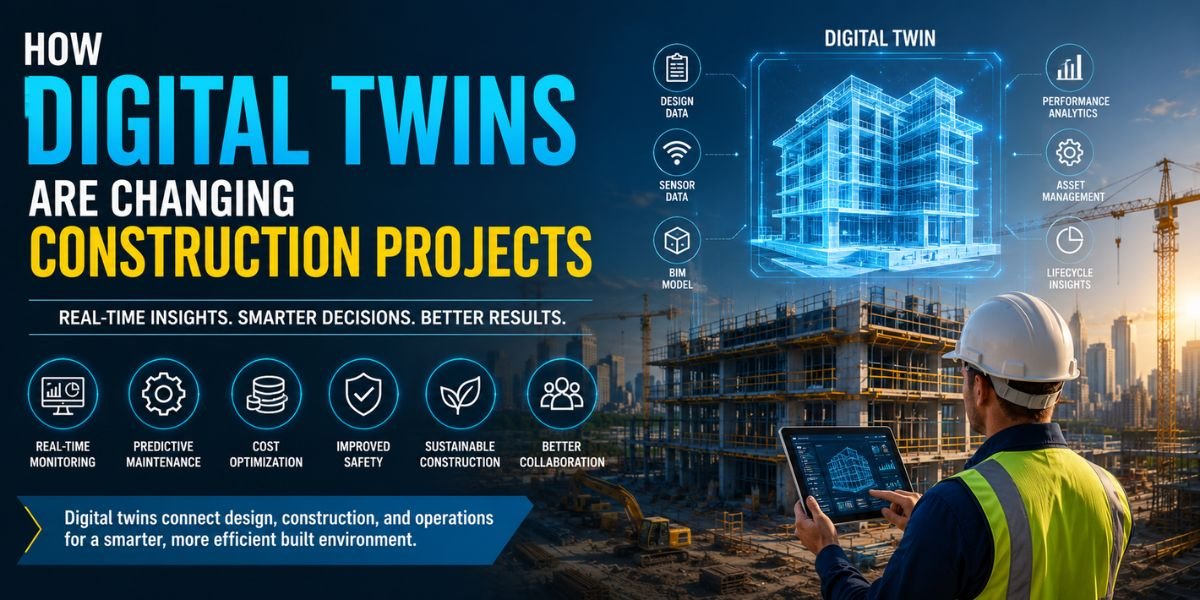
A digital twin is a dynamic digital replica that mirrors a real-world asset in real time.
Every system, component, and piece of equipment can be represented digitally.
Sensors continuously feed information from the physical structure into the virtual model.
This means project teams can monitor performance, track changes, identify issues, and test scenarios without touching the actual building.
Think of it like having X-ray vision for an entire construction project.
Pretty cool, right?
Why Construction Companies Are Embracing Digital Twins
Here’s the thing.
Construction projects are complicated.
Very complicated.
A single commercial building can involve hundreds of contractors, engineers, architects, suppliers, and stakeholders.
When communication breaks down, costs rise quickly.
Digital twins create a shared source of truth.
Everyone can access the same real-time information, reducing confusion and improving collaboration across teams.
Instead of reacting to problems after they occur, companies can predict and prevent issues before they become expensive headaches.
That’s a massive advantage.
The Connection Between BIM and Digital Twins
One of the biggest misconceptions is that BIM and digital twins are the same thing.
They’re not.
Building Information Modeling (BIM) creates intelligent digital models used during design and construction.
Digital twins take things several steps further.
A BIM model becomes a foundation for a digital twin, but the twin remains connected to real-world data throughout the building’s lifecycle.
In simple terms:
BIM helps create the building.
Digital twins help manage the building.
For a deeper understanding of BIM technology, check out our guide on BIM vs CAD: What’s the Difference? (Internal Link).
Understanding this relationship is important because many organizations start with BIM before evolving into full digital twin implementation.
Better Project Planning Before Construction Begins
One of the biggest advantages of digital twins happens long before construction starts.
Teams can simulate different scenarios, evaluate design options, and identify potential risks during planning.
What happens if equipment layouts change?
What happens if a material selection affects energy performance?
What happens if maintenance access becomes difficult?
Instead of discovering these issues after construction begins, digital twins allow teams to test solutions virtually.
That means fewer surprises and fewer costly redesigns.
And trust me, nobody enjoys explaining unexpected budget increases.
Reducing Expensive Construction Errors
Construction mistakes are incredibly expensive.
A misplaced pipe.
An incorrectly sized beam.
A mechanical system conflict.
Small errors can trigger massive delays.
Digital twins help detect issues earlier by combining design data, engineering information, and real-world project conditions.
Teams can visualize how systems interact and identify conflicts before workers arrive on-site.
The result?
Less rework.
Fewer delays.
Lower costs.
And happier project owners.
Real-Time Monitoring Changes Everything
This is where digital twins start to feel almost magical.
Once a building becomes operational, sensors can continuously collect information about:
- Temperature
- Energy consumption
- Equipment performance
- Occupancy levels
- Air quality
- Structural conditions
That information flows directly into the digital twin.
Facility managers can instantly see how a building is performing and identify potential issues before they escalate.
Instead of waiting for something to break, maintenance teams can act proactively.
It’s the difference between solving problems and preventing them altogether.
Improving Construction Site Safety
Safety remains one of the construction industry’s biggest priorities.
Digital twins can significantly improve safety planning and risk management.
Project managers can simulate dangerous scenarios, identify hazards, and evaluate site logistics before work begins.
This allows teams to create safer workflows and reduce exposure to risks.
Some advanced systems can even integrate with IoT devices and wearable technology to provide real-time safety monitoring.
When workers are safer, projects run smoother.
That’s a win for everyone involved.
Digital Twins and Sustainable Construction
Sustainability isn’t just a trend anymore.
It’s becoming an industry requirement.
Developers, governments, and property owners are increasingly focused on reducing environmental impact.
Digital twins play a major role in achieving these goals.
Because they provide real-time operational data, teams can optimize:
- Energy usage
- HVAC performance
- Water consumption
- Lighting systems
- Carbon emissions
The ability to continuously monitor and improve building performance makes sustainability efforts far more effective.
According to the World Green Building Council, improving building efficiency is one of the most important strategies for reducing environmental impact in the built environment.
This makes digital twins valuable not only during construction but throughout the entire lifespan of a building.
Infrastructure Projects Are Seeing Huge Benefits
Digital twins aren’t limited to office buildings and commercial properties.
Infrastructure projects are becoming some of the biggest beneficiaries.
Cities are using digital twins to manage:
- Bridges
- Rail systems
- Airports
- Highways
- Water networks
- Utility systems
Imagine being able to monitor an entire bridge in real time and predict maintenance needs years before structural problems occur.
That’s exactly what many infrastructure operators are beginning to do.
As urban populations continue growing, digital twins will play a critical role in managing complex infrastructure systems more efficiently.
Challenges of Digital Twin Adoption
Of course, no technology is perfect.
Digital twin implementation comes with challenges.
Some organizations struggle with:
High Initial Costs
Creating detailed digital environments requires investment in software, hardware, and expertise.
Data Management
Digital twins generate enormous amounts of information.
Managing and analyzing that data effectively can be difficult.
Integration Issues
Older systems don’t always communicate well with newer technologies.
This can create implementation challenges during adoption.
Skill Gaps
Many organizations need specialized training to fully leverage digital twin capabilities.
The good news?
As technology matures, these barriers continue to decrease.
The Future of Digital Twins in Construction
If digital twins seem impressive today, just wait.
Artificial intelligence, machine learning, IoT sensors, and cloud computing are making digital twins smarter every year.
Future systems will likely provide:
- Predictive maintenance recommendations
- Automated performance optimization
- Real-time risk forecasting
- Advanced sustainability analysis
- AI-driven project simulations
In many ways, we’re only seeing the beginning.
Experts believe digital twins could eventually become a standard part of nearly every major construction project worldwide.
Final Thoughts
The construction industry is entering a new era.
Digital twins are helping teams plan smarter, build more efficiently, reduce costs, improve safety, and optimize building performance long after construction is complete.
What once seemed like futuristic technology is quickly becoming a practical business tool.
For construction professionals looking to stay competitive, understanding digital twins is no longer optional.
It’s becoming essential.
And as the technology continues evolving, one thing is clear:
The future of construction is not just digital.
It’s intelligent.