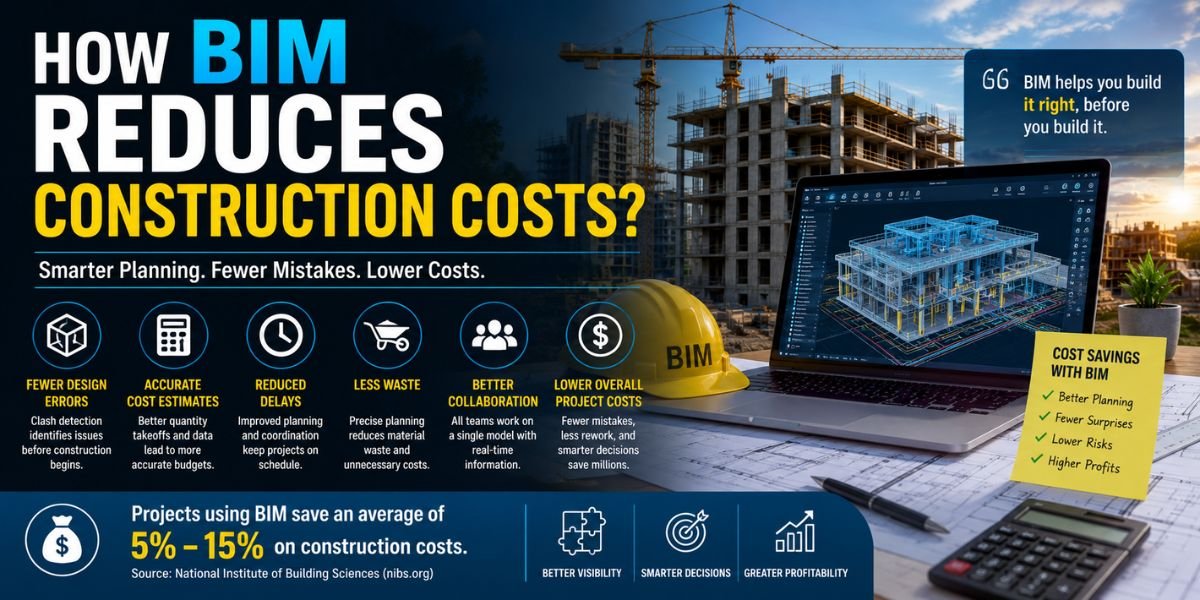
Construction projects have a reputation.
And unfortunately, it’s not always a good one.
Budget overruns.
Unexpected delays.
Design mistakes.
Last-minute changes.
If you’ve ever worked on a construction project, you already know how quickly costs can spiral out of control.
One small error on paper can turn into thousands—or even millions—of dollars in extra expenses once construction begins.
That’s exactly why Building Information Modeling (BIM) has become one of the most valuable technologies in the construction industry.
And here’s the surprising part:
BIM isn’t just helping companies build better.
It’s helping them spend less.
A lot less.
From reducing costly errors to improving collaboration and project planning, BIM is saving construction companies millions of dollars every year.
So how exactly does BIM reduce construction costs?
Let’s break it down.
First Things First: What Is BIM?
Before we dive into the savings, let’s quickly cover the basics.
BIM stands for Building Information Modeling.
But don’t let the name fool you.
It’s much more than a fancy 3D model.
BIM creates a digital representation of a building that contains detailed information about every component.
Walls.
Doors.
Windows.
Electrical systems.
Plumbing.
Structural elements.
Everything exists within a single intelligent model.
This allows architects, engineers, contractors, and project owners to work from the same source of information.
And that’s where the magic starts.
The Hidden Cost Problem in Construction
Construction projects are incredibly complex.
A typical commercial building can involve:
- Architects
- Structural engineers
- Mechanical engineers
- Electrical engineers
- Contractors
- Subcontractors
- Suppliers
- Project managers
That’s a lot of moving parts.
When teams work from separate drawings and disconnected information, mistakes become almost inevitable.
A plumbing pipe clashes with a structural beam.
An HVAC system doesn’t fit.
Materials get ordered incorrectly.
Schedules become disrupted.
Every mistake costs money.
Sometimes a lot of money.
BIM helps eliminate many of these problems before they ever reach the job site.
BIM Reduces Expensive Design Errors
Let’s start with one of the biggest cost-saving benefits.
Design errors.
In traditional workflows, different disciplines often create drawings independently.
The architect designs one thing.
The engineer designs another.
The contractor discovers conflicts later.
Usually at the worst possible moment.
During construction.
BIM allows everyone to collaborate within the same digital environment.
Potential issues become visible long before construction begins.
Finding a problem on a computer screen is dramatically cheaper than fixing it on-site.
Trust me.
Nobody wants to tear out newly installed systems because two drawings didn’t match.
Clash Detection Saves Thousands
This is where BIM really shines.
One of BIM’s most powerful features is clash detection.
Think of it like a construction project’s early warning system.
The software automatically identifies conflicts between systems before construction starts.
For example:
- A pipe running through a beam
- Electrical conduits interfering with ductwork
- Structural elements blocking mechanical equipment
Without BIM, these issues may not appear until workers are already on-site.
At that point, you’re dealing with:
- Labor costs
- Material waste
- Project delays
- Redesign expenses
With BIM, many of these clashes are discovered and resolved before a single shovel hits the ground.
That’s a huge financial advantage.
Better Quantity Takeoffs Mean Less Waste
Ever ordered too much material?
Or worse, not enough?
Both situations cost money.
Traditional estimating methods often rely on manual calculations.
And humans make mistakes.
BIM models provide highly accurate quantity takeoffs directly from the digital model.
Project teams can calculate exactly how much concrete, steel, drywall, flooring, and other materials are required.
This leads to:
- Less material waste
- More accurate purchasing
- Better budget forecasting
- Reduced storage costs
When margins are tight, these savings add up quickly.
Improved Project Planning Reduces Delays
Time is money.
Construction professionals know this better than anyone.
Every project delay creates additional costs.
Workers remain on-site longer.
Equipment rentals increase.
Schedules get pushed back.
Clients become unhappy.
BIM helps teams visualize project sequences before construction begins.
Project managers can identify bottlenecks, improve coordination, and create more realistic schedules.
This proactive planning often leads to smoother project execution and fewer costly surprises.
Better Communication Means Fewer Mistakes
Here’s something that doesn’t get enough attention.
Many construction problems are actually communication problems.
One team assumes something.
Another team interprets drawings differently.
Someone misses an update.
Suddenly the project is dealing with expensive rework.
BIM creates a shared environment where everyone accesses the same information.
Changes become visible immediately.
Updates are easier to track.
Coordination improves dramatically.
When communication improves, mistakes decrease.
And when mistakes decrease, costs follow.
BIM Helps Reduce Rework
Ask any contractor where money disappears on projects.
You’ll hear one word repeatedly:
Rework.
Few things destroy profitability faster than redoing completed work.
Imagine installing an entire section of piping only to discover it conflicts with another system.
Now workers must:
- Remove existing work
- Purchase additional materials
- Install new components
- Extend project timelines
That’s expensive.
Very expensive.
BIM significantly reduces rework by helping teams identify conflicts and coordination issues before construction begins.
Many industry studies suggest rework accounts for a substantial percentage of construction costs.
Reducing even a portion of that can generate major savings.
BIM Improves Cost Estimation Accuracy
One of the biggest challenges in construction is creating reliable budgets.
Traditional estimates often rely on assumptions and historical data.
While useful, they aren’t always precise.
BIM provides a much more detailed understanding of project requirements.
Because every component exists within the model, cost estimators can generate highly accurate forecasts.
This allows companies to:
- Prepare realistic budgets
- Reduce financial uncertainty
- Improve bidding accuracy
- Minimize unexpected expenses
Clients appreciate accurate pricing.
Contractors appreciate avoiding budget disasters.
Everyone wins.
Facility Management Savings Continue After Construction
Here’s something many people overlook.
The cost benefits of BIM don’t end when construction finishes.
Building owners continue saving money throughout the life of the facility.
BIM models contain valuable information about:
- Equipment specifications
- Maintenance schedules
- Asset locations
- Warranty information
- Building systems
Facility managers can quickly access this information whenever maintenance is required.
This reduces downtime, improves efficiency, and lowers operational costs.
In other words, BIM keeps delivering value long after the ribbon-cutting ceremony.
BIM and Digital Twins: The Next Level of Savings
The construction industry is rapidly moving toward digital twins.
A digital twin is essentially a live digital replica of a building that receives real-time data from sensors and systems.
BIM serves as the foundation for many digital twin implementations.
Together, these technologies help owners optimize energy usage, predict maintenance needs, and improve building performance.
Want to learn more?
Check out our guide on How Digital Twins Are Changing Construction Projects. (Internal Link)
The combination of BIM and digital twins is creating even greater opportunities for long-term cost savings.
Real-World Evidence Supports BIM Adoption
BIM isn’t just industry hype.
Organizations around the world have documented measurable benefits.
According to the National Institute of Building Sciences (NIBS), Building Information Modeling improves project coordination, reduces inefficiencies, and supports better decision-making throughout the building lifecycle.
As BIM adoption continues growing globally, more companies are experiencing significant improvements in cost control and project performance.
Is BIM Worth the Investment?
This is usually the next question.
After all, implementing BIM requires:
- Software
- Training
- Process changes
- Initial investment
The answer?
For most projects, yes.
Absolutely.
While BIM requires upfront resources, the long-term savings often far exceed implementation costs.
When you consider reduced errors, less rework, improved coordination, better scheduling, and more accurate budgeting, the return on investment becomes difficult to ignore.
That’s why governments, developers, and construction firms increasingly require BIM on major projects.
Final Thoughts
Construction has never been cheap.
But it doesn’t have to be wasteful.
Building Information Modeling is transforming how projects are planned, designed, constructed, and managed.
By reducing design conflicts, improving collaboration, minimizing material waste, enhancing scheduling, and preventing costly mistakes, BIM helps companies save significant amounts of money throughout the project lifecycle.
In an industry where every dollar matters, BIM has become far more than a technology trend.
It’s a competitive advantage.
And as construction projects become increasingly complex, the companies that embrace BIM will likely be the ones delivering projects faster, smarter, and more profitably than ever before.