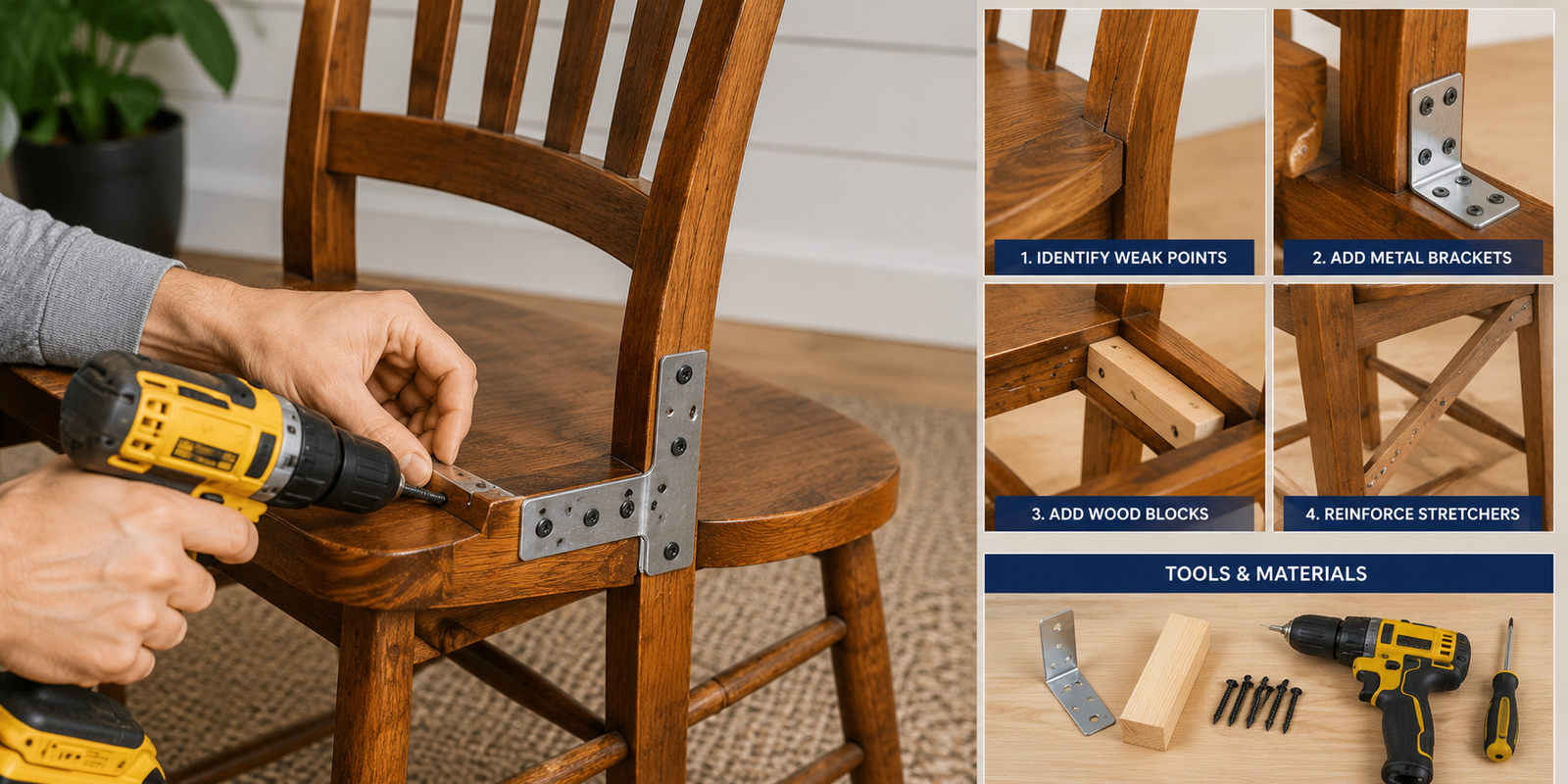
A chair can become weak long before it actually breaks. You may notice a little movement when you sit down, a slight wobble, squeaking from the frame, or joints that no longer feel as tight as they once did.
These are signs that the chair may need reinforcement.
The good news is that many wooden chairs can be strengthened at home if the wood is still structurally sound. The key is to identify which part of the chair is weak before adding glue, screws, corner blocks, or other reinforcement.
If your chair is already moving from side to side, start by checking our How to Fix a Wobbly Chair guide. It can help you determine whether the problem is caused by a loose leg, joint, or uneven frame.
Quick Answer: To reinforce a weak wooden chair, first identify the damaged or loose area, repair any failed joints, then strengthen the frame with suitable methods such as corner blocks, dowels, screws, or properly fitted wooden supports. Don’t reinforce a chair without first fixing the underlying loose or damaged joint.
Why Does a Chair Become Weak?
Wooden chairs experience repeated stress every time they’re used.
Over time, this can cause:
- Loose joints
- Worn dowels
- Cracked wood
- Loose screws
- Weak corner connections
- Movement between frame components
- Damaged chair legs
- Seat-frame separation
A chair can also become weaker when someone repeatedly rocks back on two legs or drags it across the floor.
Signs Your Chair Needs Reinforcement
Look for:
- Excessive movement
- Squeaking
- Visible gaps
- Cracks around joints
- Loose legs
- A flexible or moving seat
- A backrest that shifts
- Repeated joint failure
A squeaky chair isn’t automatically unsafe, but persistent squeaking combined with movement deserves attention. If that’s the main problem you’re experiencing, our How to Fix a Chair That Keeps Squeaking guide covers the most common causes and repairs.
Is It Safe to Reinforce a Weak Chair?
Before reinforcing the chair, inspect the wood carefully.
A chair is usually a better DIY candidate when:
- The wood is solid.
- The frame isn’t severely cracked.
- The joints are accessible.
- Only one or two areas are loose.
- There are no signs of rot.
Be much more cautious if the chair has:
- Extensive cracks
- Rotten wood
- Multiple broken legs
- Major frame damage
- Missing structural components
- Severe movement under light pressure
If the chair is badly compromised, professional repair or replacement may be safer.
Tools and Materials You’ll Need
Depending on the reinforcement method, you may need:
- Wood glue
- Wooden corner blocks
- Wood dowels
- Suitable screws
- Drill
- Drill bits
- Screwdriver
- Clamps
- Sandpaper
- Wood shims
- Measuring tape
- Pencil
- Clean cloth
- Safety glasses
You won’t need every item for every repair.
7 Ways to Reinforce a Weak Chair
1. Repair Loose Joints First
Before adding reinforcement, deal with the original source of weakness.
A loose joint can make the entire chair frame move.
If the joint is still structurally sound, you may be able to separate it, clean the old adhesive, apply suitable wood glue, realign the components, and clamp them until fully cured.
For a more detailed repair process, see our How to Fix a Loose Wooden Chair Joint guide.
Why This Matters
Adding a brace to a loose joint without repairing the joint itself may only hide the problem temporarily.
The reinforcement should support a sound connection—not replace basic joint repair when the original joint can be restored.
2. Add Wooden Corner Blocks
Wooden corner blocks are one of the simplest ways to strengthen certain chair-frame connections.
A small block can be installed where two frame components meet.
The block can provide additional support and reduce movement around the connection.
Basic Process
- Identify the weak corner.
- Make sure the surrounding wood is solid.
- Prepare a suitably sized wooden block.
- Apply suitable adhesive if appropriate.
- Position the block securely.
- Add suitable screws if the construction allows.
- Allow adhesive to cure fully.
The block should not interfere with the chair’s appearance or moving components.
3. Reinforce a Joint With a Wooden Dowel
A dowel can strengthen some wooden connections by creating an additional mechanical connection between components.
This method requires accurate drilling.
The basic process is:
- Mark the reinforcement location.
- Measure carefully.
- Drill aligned holes.
- Prepare an appropriate dowel.
- Apply suitable adhesive.
- Insert the dowel.
- Clamp the joint.
- Allow it to cure.
- Trim and finish the exposed area if necessary.
Important
A badly aligned dowel can distort the frame.
If you’re not comfortable drilling accurately into a structural chair joint, choose a simpler reinforcement method or seek professional help.
4. Replace Damaged Screws
Sometimes a chair feels weak because its existing hardware is worn, loose, or no longer holding properly.
Inspect:
- Screws
- Bolts
- Nuts
- Brackets
- Mounting plates
Replace damaged hardware with appropriately sized alternatives.
Don’t simply install a much larger screw into a damaged hole.
An oversized fastener can split the surrounding wood.
5. Reinforce Weak Chair Legs
Chair legs carry a significant portion of the load.
If a leg is loose, cracked, or moving independently from the frame, determine whether the problem is with the leg itself or the joint connecting itFor a leg that is simply loose, our How to Fix a Loose Chair Leg guide provides more specific repair methods.
If the leg is cracked or broken, don’t treat it as a simple reinforcement problem.
A badly damaged leg may need to be repaired or replaced before additional reinforcement is added.
6. Strengthen the Seat Frame
A weak seat frame can make the entire chair feel unstable.
Turn the chair upside down and inspect the rails beneath the seat.
Look for:
- Gaps
- Loose joints
- Cracks
- Missing screws
- Broken corner connections
Suitable wooden corner blocks can sometimes strengthen these connections.
However, make sure the reinforcement is attached to solid wood.
Don’t attach a brace to an already cracked or rotten section and expect it to carry the load safely.
7. Add a Suitable Structural Brace
Some chair designs can benefit from a carefully positioned brace.
Depending on the construction, this might be:
- A wooden support
- A corner brace
- A metal reinforcement plate
- A replacement frame member
The brace needs to be positioned where it can actually transfer load into strong parts of the frame.
Avoid Random Bracing
More braces don’t automatically mean a stronger chair.
Poorly positioned hardware can interfere with the chair’s construction or create new stress points.
How to Reinforce a Chair Without Making It Look Bad
One concern with DIY furniture repair is appearance.
Fortunately, many reinforcements can be installed discreetly.
Use the Underside
Seat-frame reinforcement is often less noticeable underneath the chair.
Match the Wood
For visible wooden blocks or dowels, choose a compatible wood where practical.
Sand Carefully
Smooth repaired surfaces before refinishing.
Match the Finish
Stain or paint can help blend visible repairs with the existing chair.
For valuable or antique furniture, avoid aggressive sanding or permanent modifications without considering professional restoration.
How to Reinforce a Chair Leg Joint
If the chair leg is moving where it meets the frame, don’t immediately install a bracket.
First determine why the joint is loose.
The joint may need:
- Cleaning
- Re-gluing
- A new dowel
- A wooden shim
- Appropriate hardware
- Replacement wood
If the chair has both a weak frame and a cracked component, repair the structural damage before adding cosmetic reinforcement.
How to Reinforce a Chair That Keeps Wobbling
A chair that keeps wobbling may have more than one problem.
Check:
- Each leg
- The floor contact
- Leg-to-frame joints
- Seat-frame connections
- Backrest joints
- Cracks
- Loose hardware
If one joint is loose, repairing that joint may solve the entire problem.
If several joints are loose, the chair may require broader frame reinforcement.
Common Mistakes When Reinforcing a Chair
Adding Brackets Without Fixing Loose Joints
A bracket can’t always compensate for a failed joint.
Using Screws That Are Too Long
The screw can emerge through the opposite side or damage another component.
Over-Tightening Hardware
Too much pressure can crush or split wood.
Reinforcing Rotten Wood
Weak or rotten wood can’t reliably hold new hardware.
Using Too Much Glue
Excess adhesive doesn’t automatically create a stronger repair.
Ignoring the Original Cause
If the chair is repeatedly overloaded or rocked, reinforcement alone won’t prevent future problems.
How Long Should a Reinforced Chair Cure?
If you’ve used adhesive, follow the manufacturer’s curing instructions.
Don’t assume the chair is ready simply because the glue feels dry.
Keep the chair unloaded until the recommended curing period has passed.
This is especially important when the repaired area is structural.
How to Test a Reinforced Chair
After the repair has fully cured, inspect everything carefully.
Step 1: Check the Joints
Look for gaps or movement.
Step 2: Check the Legs
Make sure all legs sit correctly on the floor.
Step 3: Test the Frame
Apply gentle pressure from different directions.
Step 4: Listen
Watch for new cracking or unusual movement.
Step 5: Test Gradually
Don’t immediately drop your full body weight onto the chair.
If the chair remains stable during gradual testing, it is a better indication that the reinforcement has worked.
When Should You Replace a Weak Chair?
Reinforcement isn’t always the best answer.
Consider replacing the chair or getting professional restoration when:
- Multiple structural components are broken.
- The wood is rotten.
- Several legs are badly damaged.
- The frame is severely distorted.
- The chair repeatedly fails after repair.
- Important components are missing.
If the chair has significant monetary or sentimental value, professional furniture restoration may be the better option.
How to Keep a Chair Strong for Longer
Once you’ve repaired and reinforced the chair, proper use matters.
Avoid Rocking
Don’t lean back on two legs.
Lift Instead of Dragging
Dragging places stress on joints.
Check Hardware
Inspect screws and bolts periodically.
Repair Small Problems Early
A slightly loose joint is easier to repair than a completely failed one.
Keep Wooden Furniture Away From Prolonged Moisture
Excess moisture and repeated environmental changes can affect wood over time.
Final Thoughts
A weak wooden chair doesn’t necessarily need to be replaced.
The most effective approach is to find the source of weakness first, repair the underlying problem, and then reinforce the structure where necessary.
Wooden corner blocks, dowels, suitable hardware, and structural braces can all be useful, but the correct method depends on the chair’s construction and the condition of the wood.
If the frame is severely cracked, rotten, or unstable, don’t rely on a simple DIY reinforcement.
A chair should be more than quiet or visually repaired—it should be structurally sound and stable before anyone sits on it.
FAQs
How can I make a weak wooden chair stronger?
First identify the weak area, repair loose joints, and then use appropriate reinforcement such as corner blocks, dowels, or suitable hardware.
Can I reinforce a chair with screws?
Yes, when the chair’s construction allows it. Use appropriately sized screws and avoid fastening into damaged or rotten wood.
Are wooden corner blocks good for chair repair?
They can be useful for strengthening certain frame corners, particularly underneath a chair seat where they can provide additional support.
Can glue strengthen a weak chair?
Glue can restore suitable wooden joints, but it shouldn’t be used to hide severely damaged or missing structural material.
Should I reinforce a cracked chair leg?
A minor repairable crack may sometimes be reinforced, but a severely cracked or broken load-bearing leg may need replacement.
Why does my reinforced chair keep becoming loose?
The original cause may still exist, such as excessive movement, poor joint fit, damaged wood, or repeated stress.
Is a weak chair dangerous?
It can be if the weakness affects a load-bearing structural component. Don’t use a chair that collapses, shifts significantly, or has severe structural damage.