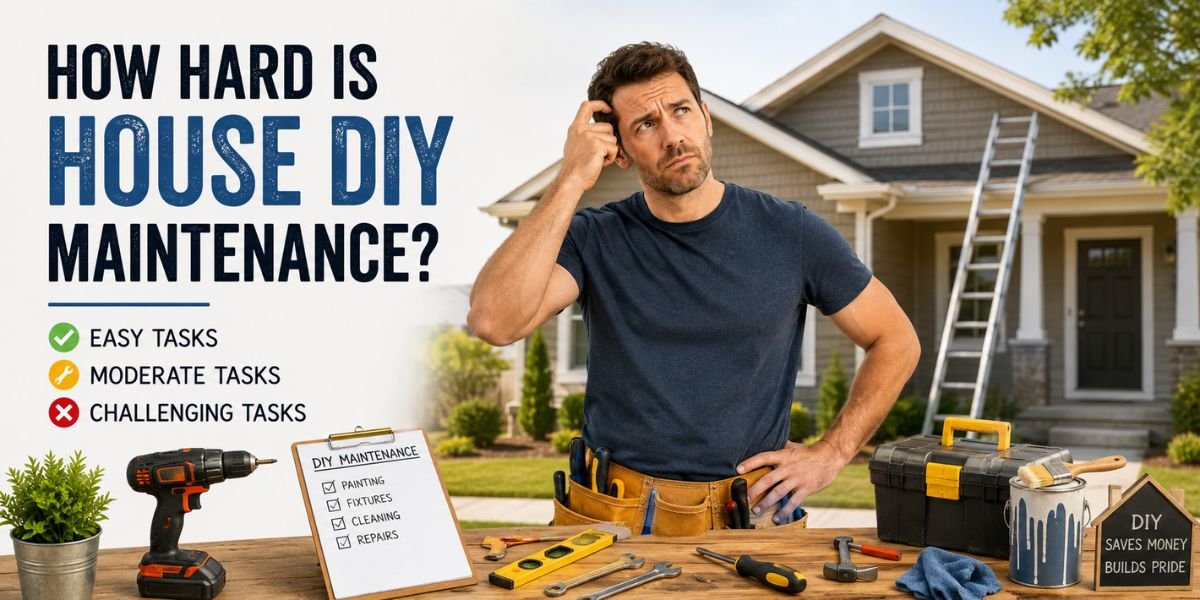
I get this question a lot, usually from someone who just closed on their first house and is standing in the garage staring at a toolbox they don’t fully know how to use. Or it’s a homeowner who’s been renting for years and suddenly realizes nobody’s coming to fix the leaky faucet anymore — it’s on them now.
So how hard is house DIY maintenance, really? The honest answer: it depends entirely on the task. Some jobs — replacing a furnace filter, caulking a tub, tightening a loose hinge — take fifteen minutes and zero prior experience. Others — rewiring a circuit, patching a foundation crack, or dealing with roofing repairs — require real skill, the right tools, and sometimes a permit. Knowing which category a job falls into is the difference between saving a few hundred dollars and turning a small problem into an expensive one.
Quick Answer
Most routine house maintenance is beginner-friendly and safe to DIY — think cleaning gutters, changing HVAC filters, resealing grout, or repainting trim. Moderate tasks like installing flooring, patching drywall, or replacing a faucet require some skill but are learnable with patience and the right guide. Anything involving electrical panels, gas lines, structural framing, load-bearing walls, or roofing should generally go to a licensed professional, both for safety and because many of these jobs legally require permits and inspections.
What “DIY Maintenance” Actually Covers
When people ask how hard house maintenance is, they’re usually lumping together three very different categories of work:
Preventive maintenance — the small, recurring tasks that keep a house running smoothly. Cleaning gutters, servicing HVAC systems, checking for water intrusion, testing smoke detectors.
Repair work — fixing something that’s already broken. A running toilet, a cracked tile, a squeaky door, a leaking pipe joint.
Improvement projects — upgrades that go beyond fixing what’s broken, like refinishing a deck, updating a bathroom, or finishing a basement.
Each category has its own difficulty curve, and I’ll break those down below so you can gauge where a specific project falls before you commit a weekend to it.
Easy DIY Maintenance (Beginner Level)
These are the jobs I tell every new homeowner to learn first, because they’re low-risk and high-reward.
- Changing HVAC filters — takes five minutes, no tools, and directly affects your energy bills and indoor air quality.
- Cleaning gutters and downspouts — prevents water damage to your fascia, siding, and foundation. Needs a ladder and basic caution, nothing more.
- Caulking around tubs, sinks, and windows — stops moisture intrusion before it becomes a mold problem.
- Touch-up painting — cosmetic, forgiving, and a good way to build confidence with basic tools.
- Replacing cabinet hardware, light switches (with power off), and showerheads — minimal risk, quick payoff.
Tools Required: screwdriver set, caulking gun, ladder, basic cleaning supplies
Skill Level: Beginner
Estimated Time: 15 minutes to 2 hours depending on task
Safety Precautions: Always cut power before touching switches or outlets. Use ladder safety practices — three points of contact, no overreaching.
Common Errors: Skipping filter changes until the HVAC system struggles, using the wrong caulk type for wet areas (always use silicone-based caulk in showers and tubs, not acrylic).
Moderate DIY Projects (Some Skill Required)
This is where things get more interesting — and where a lot of homeowners either build real confidence or get in over their heads.
- Drywall patching — small holes are easy; anything larger than a dinner plate requires cutting in a new piece and taping/mudding seams properly, which takes practice to get smooth.
- Installing flooring (laminate, vinyl plank, tile) — doable for a patient DIYer, but requires an underlayment or vapor barrier in certain rooms, proper subfloor prep, and accurate measuring.
- Replacing a faucet or toilet — plumbing basics, shutoff valve knowledge, and patience with old, corroded fittings.
- Painting an entire room, including trim — not hard technically, but time-consuming if done correctly with proper prep (sanding, priming, taping).
- Building shelving or basic framing for a closet or storage area — introduces you to stud finding, level and square work, and fastening techniques.
Tools Required: drill/driver, level, stud finder, basic hand tools, tile or flooring cutter (task-dependent)
Skill Level: Intermediate
Estimated Time: Half a day to a full weekend
Safety Precautions: Turn off water supply lines before plumbing work. Wear a dust mask when sanding drywall or cutting tile.
Common Errors: Not checking a floor for level before installing flooring, over-tightening plumbing connections (which cracks fittings), skipping primer on new drywall patches so paint sheen doesn’t match.
Hard or Risky DIY Projects (Leave to Professionals)
This is the category where I tell homeowners: save your money for a contractor, not because you’re incapable, but because the risk-to-reward ratio isn’t in your favor.
- Electrical panel work — anything beyond swapping a switch or outlet with power off should go to a licensed electrician. Panels involve live current strong enough to kill, and most jurisdictions require a permit and inspection for panel changes.
- Roofing repairs — beyond patching a small shingle, roofing work involves fall risk, proper flashing techniques to prevent leaks, and steep-slope safety gear most homeowners don’t own.
- Removing or altering load-bearing walls — this is structural work. Get it wrong and you’re looking at sagging floors, cracked drywall throughout the house, or worse. This always requires an engineer’s input and a permit.
- Foundation repair — cracks can be cosmetic or structural, and telling the difference requires experience. A concrete slab issue misdiagnosed as “just settling” can turn into a five-figure repair.
- HVAC system replacement — refrigerant handling requires EPA certification, and improper installation voids warranties and tanks efficiency.
- Gas line work — never DIY. Full stop. This is a life-safety issue every single time.
If you’re ever unsure whether a project crosses into this category, it’s worth checking your local building department’s permit requirements before you start — a quick call can save you from a project that gets red-tagged halfway through.
Cost Breakdown: DIY vs Hiring a Pro
Costs vary quite a bit by region, labor rates, and material choices, so treat these as general ballpark ranges rather than fixed numbers.
Budget-friendly DIY tasks (gutter cleaning, caulking, filter changes): typically $10–$50 in materials, versus $75–$200 if you hire it out.
Mid-range projects (flooring installation, drywall repair, faucet replacement): DIY material costs often run $200–$800 depending on square footage and finish quality, compared to $500–$2,500 for professional labor and materials combined.
Premium/complex projects (roofing, electrical panel upgrades, structural work): Professional costs can run from a few thousand dollars into five figures depending on scope. These aren’t areas where DIY savings are worth the risk — mistakes here often cost more to fix than the original job would have cost a licensed pro.
The general rule I give clients: if a mistake could hurt you, damage the structure, or void your homeowner’s insurance, that’s when the “DIY savings” math stops making sense.
Common Mistakes Homeowners Make with DIY Maintenance
- Skipping the “why” behind maintenance tasks. Cleaning gutters isn’t just tidiness — clogged gutters cause water to pool against your foundation and fascia, leading to rot and even foundation moisture issues over time.
- Ignoring small leaks. A slow drip under a sink seems minor until you find soft, water-damaged subfloor a year later.
- Using the wrong materials. Interior caulk in a shower, non-rated wire for outdoor use, or the wrong vapor barrier under flooring — small material mismatches cause big problems down the line.
- Not pulling permits when required. Unpermitted work can complicate a home sale later and may not be covered by insurance if something goes wrong.
- Underestimating time. DIY projects almost always take longer than expected, especially the first time you’re learning a new skill.
Maintenance Tips to Make DIY Easier
- Keep a seasonal maintenance checklist — HVAC filters, gutter cleaning, caulk inspection, smoke detector batteries — so nothing slips through the cracks.
- Invest in a basic but quality tool set before you need it. A good drill, level, stud finder, and multimeter cover the majority of home maintenance tasks.
- Take photos of your home’s systems (electrical panel, water shutoff, HVAC model number) so you’re not scrambling during an emergency.
- Learn where your main water shutoff and breaker panel are located before you ever have an emergency — this alone prevents a lot of water and fire damage.
Professional vs DIY Comparison
| Factor | DIY | Professional |
|---|---|---|
| Cost | Lower upfront, but risk of costly mistakes | Higher upfront, but warrantied and code-compliant |
| Time | Longer, especially for beginners | Faster, done by experienced crews |
| Skill Required | Varies by task | Licensed expertise, especially for electrical/structural |
| Permits | Homeowner must research and pull if required | Contractor typically handles permitting |
| Risk | Higher for structural, electrical, gas work | Lower — insured and code-compliant |
Safety Considerations
Whenever you’re taking on a maintenance project, a few safety basics apply across the board: always cut power at the breaker before working near outlets or switches, shut off water supply lines before plumbing repairs, wear a respirator when sanding drywall or old paint (especially in homes built before 1978, due to lead paint risk), and never work on a roof alone or without fall protection. If a task requires a permit in your area, don’t skip it — building codes exist because of decades of hard-learned lessons about what goes wrong when they’re ignored.
Expert Recommendations
After years of walking through homes at every stage of DIY ambition, here’s my honest take: start small, build confidence with low-risk tasks, and treat “hard” as a signal to slow down, not necessarily to hire out immediately. Some of the best DIYers I know started with painting and caulking and worked their way up to installing their own flooring and building out a basement. But know your limits — structural, electrical, and gas work is where experience and licensing genuinely matter for safety, not just quality.
Conclusion
So, how hard is house DIY maintenance? Easier than most people expect for routine upkeep, moderately challenging for repair and improvement projects, and genuinely risky if you skip straight to structural, electrical, or roofing work without the right knowledge. The key is matching the project to your actual skill level, being honest about what you don’t know yet, and knowing when a licensed professional is the smarter investment. Start with a seasonal maintenance checklist, build your tool collection gradually, and tackle projects in order of increasing difficulty — that’s how you build real, useful DIY skill without expensive mistakes along the way.
FAQs
1. What’s the easiest DIY home maintenance task for beginners?
Changing HVAC filters and cleaning gutters are the best starting points — low risk, quick to learn, and immediately useful.
2. Can I do my own electrical work?
Simple tasks like replacing a switch or outlet with the power off are generally fine for confident DIYers, but panel work, new circuits, and rewiring should go to a licensed electrician, both for safety and because most areas require permits and inspections for this work.
3. How do I know if a wall is load-bearing before removing it?
You typically can’t tell just by looking — this requires checking the framing direction, foundation layout, and often consulting a structural engineer or contractor before any demolition.
4. Is DIY flooring installation worth it?
For laminate or vinyl plank flooring, yes — it’s a manageable weekend project for most homeowners. Tile and hardwood require more precision and are better suited to intermediate or advanced DIYers.
5. What maintenance tasks should never be DIYed?
Gas line work, structural/load-bearing wall changes, electrical panel upgrades, and major roofing repairs should always go to licensed professionals.
6. How often should I do seasonal home maintenance?
Most homeowners benefit from a quarterly checklist covering HVAC, gutters, caulking, and safety devices, with a more thorough inspection each spring and fall.
7. Do I need a permit for DIY home repairs?
It depends on the scope and your local building codes — cosmetic work rarely needs one, but plumbing, electrical, and structural changes often do. Check with your local building department before starting.
8. How can I learn DIY skills safely as a beginner?
Start with low-risk projects, use trusted how-to resources — our guide on essential home maintenance checklists is a good starting point — and don’t hesitate to consult the U.S. Consumer Product Safety Commission for safety guidance on tools and materials before tackling something new.