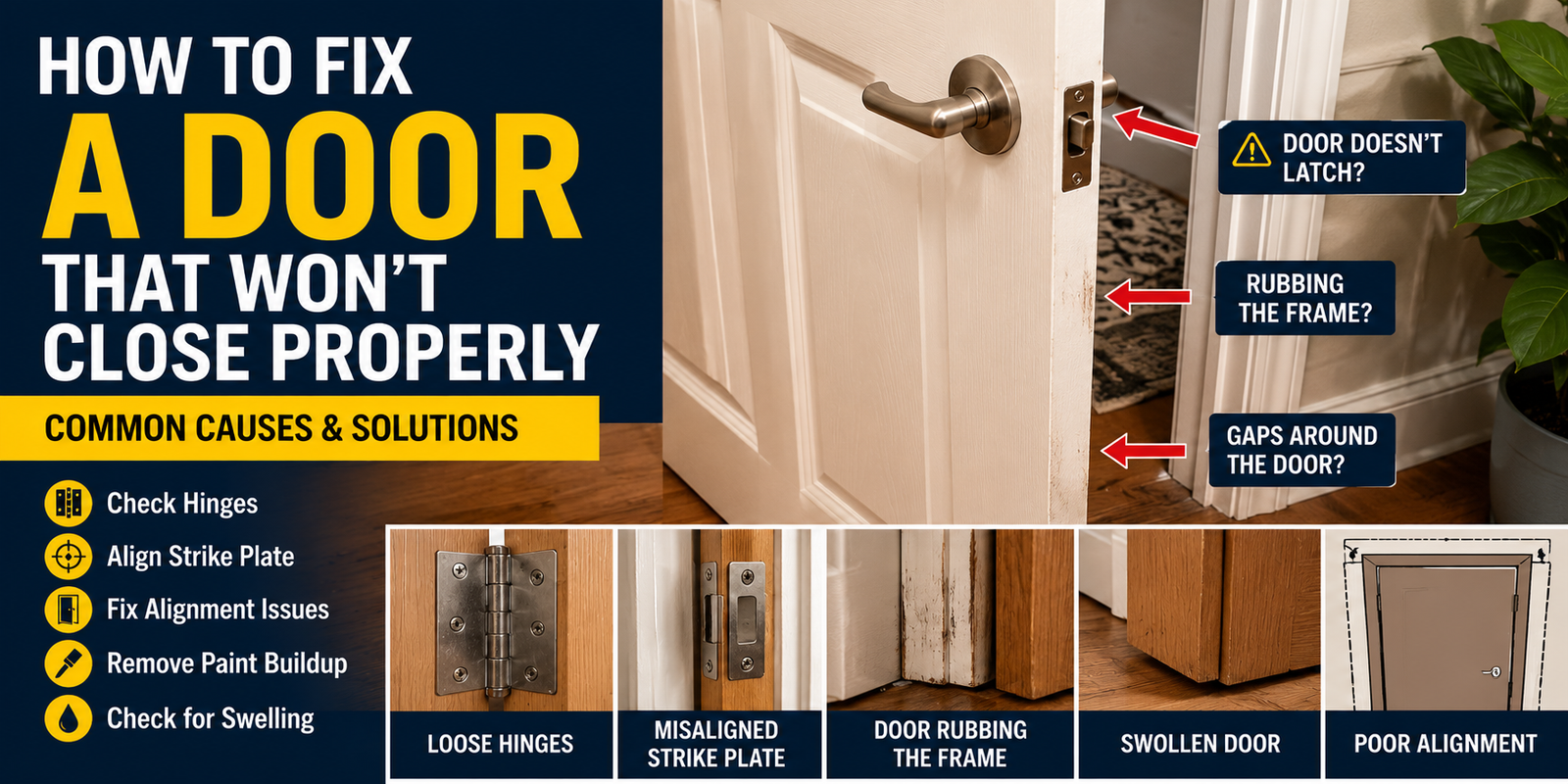
A door that won’t close properly can be one of those small household problems that gets more annoying every day.
Maybe the door closes but the latch doesn’t catch. Perhaps you have to push the handle upward before it shuts. Or the door reaches the frame but seems to stop just before closing completely.
Before replacing the door or making a large cut, take a few minutes to find out where the problem is actually happening.
In many cases, the cause is something simple: a loose hinge, a shifted strike plate, paint buildup, a swollen edge, or a door that has gradually moved out of alignment.
The repair becomes much easier once you know which one you’re dealing with.
Quick Answer
To fix a door that won’t close properly, first check whether the door is rubbing against the frame or whether the latch is failing to line up with the strike plate. Tighten loose hinge screws, inspect the gaps around the door, and check the latch and strike plate alignment.
If the door is rubbing, deal with the alignment or clearance problem first. If the door closes but the latch does not catch, focus on the strike plate and latch instead.
The key is to diagnose the problem before removing material or replacing hardware.
First, Find Out Where the Door Is Stopping
Close the door slowly instead of pushing it shut.
Watch the door as it moves toward the frame.
Does it:
- Rub against the top corner?
- Catch along the side?
- Stop near the bottom?
- Close completely but fail to latch?
- Need extra pressure before it shuts?
This simple test can tell you a lot.
If the door physically cannot reach the frame, you probably have an alignment, swelling, paint, or hinge problem.
If the door reaches the frame but the latch misses the strike plate, the problem is more likely related to the hardware.
Don’t start adjusting anything until you know which situation you’re dealing with.
1. Check the Hinges
Loose hinges are one of the first things I would inspect.
A door is carrying its own weight through the hinges every time it opens and closes. If a hinge becomes loose, the door can shift slightly inside the frame.
You may not notice the movement by looking at the hinge itself, but you can often see its effect in the gaps around the door.
Open the door and check each hinge.
Look for:
- Loose screws
- Hinge plates pulling away from the wood
- Damaged screw holes
- A hinge that is not sitting flat
- Uneven gaps around the door
Tighten loose screws carefully.
Don’t keep tightening once the screw is secure. If the screw simply spins without gripping, the problem may be damaged wood rather than a loose screw.
If the hinges appear to be the cause, our guide on How to Adjust Door Hinges walks through the adjustment process in more detail.
2. Check the Door Gap
The gap between the door and frame can give you another useful clue.
Look at the gap along the hinge side, top and latch side.
It doesn’t need to be perfectly identical everywhere, but a sudden change in the gap can indicate that the door has shifted.
For example, if the gap is very narrow at the top corner but much wider at the bottom, the door may have moved slightly out of alignment.
Don’t automatically solve this by sanding the narrow section.
First check the hinges.
Removing wood can create more clearance, but it won’t correct a door that is hanging incorrectly.
3. See If the Door Is Rubbing
Run your hand carefully along the door edge and frame while slowly closing the door.
You may be able to feel exactly where the contact occurs.
If the door rubs before it reaches the frame, mark the area lightly with a pencil.
Then open the door and inspect that section.
Paint buildup, swelling, hinge movement, or a shifted frame can all reduce the available clearance.
If rubbing is the main reason your door won’t close, see our detailed guide on How to Fix a Door That Rubs before reaching for sandpaper.
That article explains how to identify the rubbing point and decide whether the problem needs hinge adjustment, clearance work, or another repair.
4. Inspect the Strike Plate
If the door reaches the frame but the latch doesn’t catch, stop looking at the door edge for a moment.
The strike plate may simply be out of position.
The strike plate is the metal plate attached to the door jamb that receives the latch.
Close the door slowly and watch where the latch hits.
If the latch is striking above, below, or to the side of the opening, the two pieces are no longer properly aligned.
You may be able to correct a small misalignment by loosening the strike plate screws and repositioning the plate slightly.
Make small changes.
Test the door after each adjustment.
A door that requires force to latch should not simply be slammed harder. That can damage the latch, frame, or surrounding finish over time.
5. Check for Paint Buildup
Paint can quietly create door problems.
If a door or frame has been painted several times, the extra layers can reduce the clearance around the opening.
Look closely at the area where the door stops.
You may see a thick ridge of paint or several overlapping layers.
If that’s the problem, carefully remove only the excess material that is interfering with the door.
Don’t sand a large section of the door just because one small area is tight.
After removing the buildup, test the door before applying another coat of paint.
Adding another heavy layer immediately can recreate the same problem.
6. Look for Swelling
Wood changes with moisture.
An interior door near a bathroom, kitchen, laundry area, or other humid space can swell enough to affect its clearance.
If the door worked normally for months or years and suddenly became difficult to close during a humid period, swelling is worth considering.
Look for a tight area along the edge of the door.
If you find one, don’t remove a large amount of wood immediately.
First consider whether moisture is causing the change.
If the moisture problem continues, sanding the door may only provide temporary relief.
7. Check Whether the Door Has Sagged
A sagging door often shows several symptoms at the same time.
It may:
- Rub against the frame
- Have uneven gaps
- Make the latch difficult to operate
- Need lifting slightly to close
- Look lower on one side
If you notice several of these symptoms together, focus on the hinges and alignment before changing the door itself.
A small hinge adjustment can sometimes bring the door back into position without cutting or sanding anything.
This is one reason I prefer to diagnose the door first rather than immediately modifying the wood.
8. Inspect the Frame
If the hinges look fine and the hardware is aligned, take a closer look at the frame.
Older homes can have door frames that are no longer perfectly square. Previous repairs, settling, moisture, or renovation work can also change the opening.
Look for:
- Uneven gaps
- Cracks around the frame
- Trim that has shifted
- A jamb that appears twisted
- A door that sits noticeably closer to one side
If the frame is significantly out of square, adjusting the door alone may not completely solve the problem.
This is especially important when several doors in the same part of the house begin having similar problems.
9. Check the Latch Itself
Sometimes the alignment is fine but the latch mechanism is not working correctly.
Open the door and operate the handle several times.
The latch should move smoothly in and out.
If it feels stiff, sticks, or doesn’t extend fully, the hardware may need cleaning, lubrication, adjustment, or replacement.
You can also compare the latch position with the strike plate opening.
If the latch is not extending far enough to engage properly, moving the strike plate may not solve the underlying problem.
A Simple Diagnostic Trick
If you’re not sure whether the latch or strike plate is the problem, close the door slowly while watching the latch.
You can also put a small, washable mark on the latch and close the door gently.
The mark can show where the latch is contacting the strike plate.
This gives you a much clearer idea of whether the hardware is sitting too high, too low, or too far to one side.
It is a simple diagnostic step, but it can save a lot of unnecessary adjustment.
What If the Door Is Sticking and Won’t Close?
If your door both sticks and refuses to close smoothly, don’t treat those as completely separate problems.
The same alignment issue may be responsible for both symptoms.
Check the rubbing point, hinges, frame and surrounding moisture.
If the door is sticking against the frame, our guide on How to Fix a Door That Sticks can help you work through the problem before removing material from the door.
The important thing is to avoid sanding first and asking questions later.
Common Mistakes to Avoid
Sanding before checking the hinges
A loose hinge can change the door’s position.
Sanding the edge may hide the symptom without fixing the cause.
Moving the strike plate too much
Strike plate adjustments should be small.
Move it gradually and test the latch after every change.
Over-tightening screws
A screw that is already secure doesn’t need to be forced tighter.
Over-tightening can damage the wood around the screw hole.
Ignoring recent changes
Think about what happened before the problem appeared.
Was the room painted? Was new flooring installed? Was the door removed? Was the frame repaired?
Sometimes the timing tells you more than the door itself.
Replacing hardware unnecessarily
Don’t replace a perfectly good hinge or latch before confirming that it is actually defective.
Many door problems are caused by alignment rather than failed hardware.
When Should You Stop DIY Repairs?
Most minor door alignment and latch problems are reasonable DIY jobs.
However, get professional help if:
- The door frame is badly damaged.
- The surrounding wall has shifted or cracked.
- Several doors suddenly develop the same problem.
- The door is part of an exterior security system.
- The door cannot be closed or locked safely.
- The frame is significantly out of square.
- You have already made several adjustments without improvement.
If the problem appears to involve movement in the surrounding structure, repeatedly adjusting the hinges may only hide the bigger issue.
Quick Troubleshooting Table
| Problem | Possible cause | First check |
|---|---|---|
| Door rubs at the top | Hinge or alignment issue | Top hinge |
| Door rubs on the side | Swelling, paint or alignment | Rubbing point |
| Door reaches frame but won’t latch | Strike plate alignment | Latch and strike plate |
| Door needs lifting to close | Sagging hinges | Hinge screws |
| Door suddenly became difficult to close | Moisture or recent movement | Frame and door edge |
| Latch feels stiff | Hardware problem | Latch mechanism |
| Several doors have the same issue | Frame or building movement | Surrounding area |
Final Thoughts
A door that won’t close properly doesn’t necessarily need a new door, new frame, or expensive repair.
Start with the simplest diagnosis.
Find where the door stops. Check the hinges. Look at the gaps. Inspect the latch and strike plate. Then consider paint, swelling, and frame movement.
Only after you’ve identified the actual problem should you remove material or replace hardware.
That approach may take an extra few minutes at the beginning, but it can prevent you from turning a small adjustment into a much bigger repair.
For more practical DIY home improvement guides, visit the IngeBIM Blog and explore the related Door Repair articles.