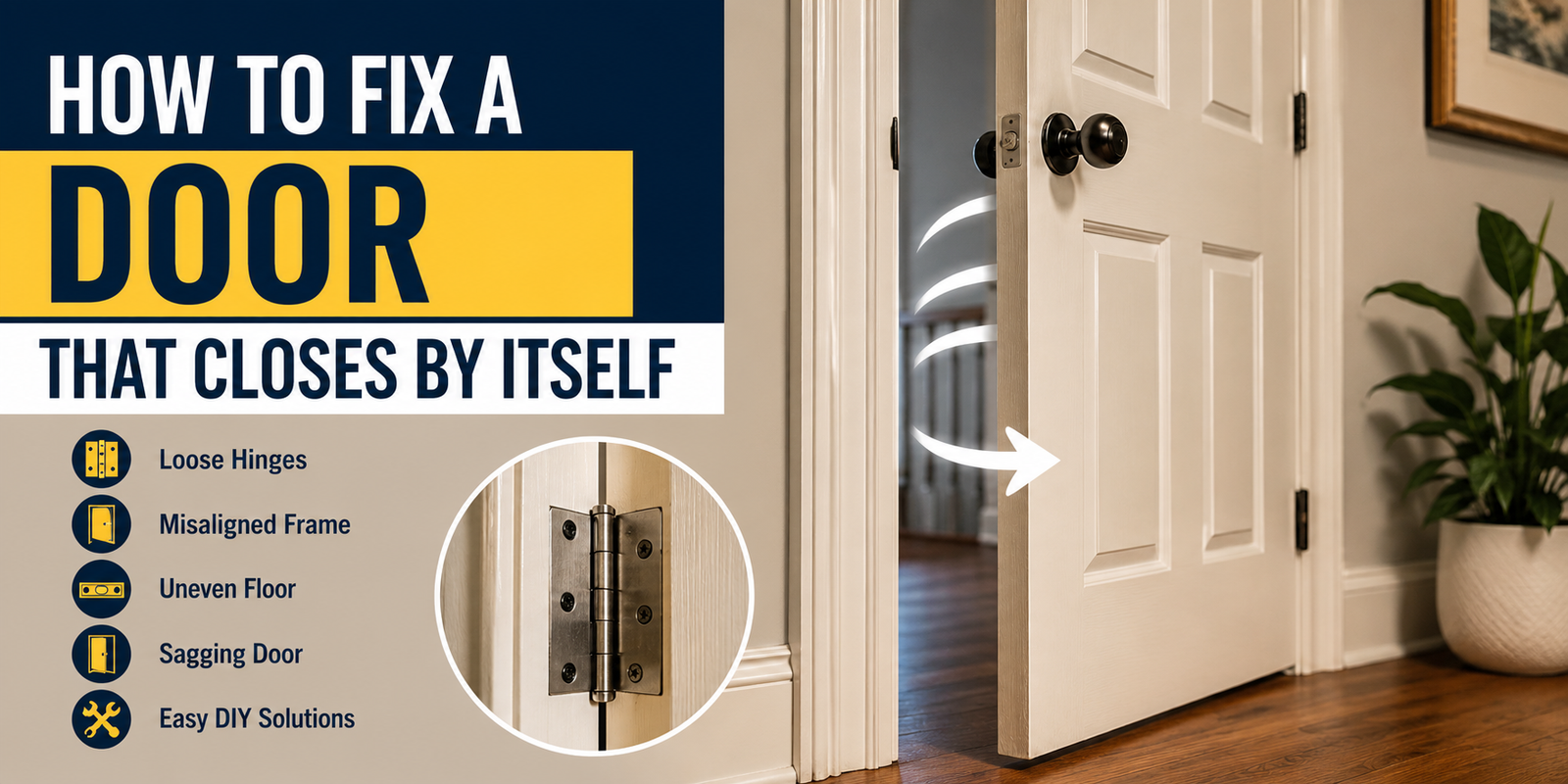
There are few things more annoying than opening a door, walking away, and watching it slowly swing shut behind you.
Sometimes it happens so gradually that you barely notice it. Other times the door moves quickly enough to slam into the frame. Either way, a door that won’t stay where you leave it usually means something about its alignment has changed.
The good news is that you probably don’t need a new door.
Loose hinges, an uneven frame, a sloping floor, or small changes in the way the door sits can all cause it to move toward the closed position. The important part is finding the cause before trying to force the door into a different position.
Quick Answer
If a door closes by itself, start by checking the hinges and the alignment of the door frame. Tighten loose hinge screws and look for uneven gaps around the door. If the hinges are secure, check whether the frame is plumb and whether the floor slopes toward the closed position.
Make one adjustment at a time and test the door after each change. If the door suddenly developed the problem after years of working normally, pay particular attention to loose hinges, frame movement, or recent flooring and renovation work.
Why Does a Door Close by Itself?
A properly aligned door should normally stay close to the position where you leave it.
When the door is slightly out of alignment, gravity can pull it toward the closed position. The change may be small enough that you cannot see it by simply looking at the door.
Common causes include:
- Loose hinge screws
- Misaligned or worn hinges
- A door frame that is not perfectly plumb
- An uneven floor
- A door that has sagged over time
- Previous repairs that changed the alignment
- Changes around the frame caused by settling or renovation
The first job is therefore not to fix anything.
It is to find out what is making the door move.
1. Start With a Simple Swing Test
Before touching the hinges, open the door about halfway.
Let go of the handle and watch what happens.
Does the door immediately begin closing?
Does it move slowly?
Does it stop at one particular position?
Now repeat the test with the door opened a little wider.
This simple test gives you useful information. If the door consistently moves toward the same position, the problem is likely related to alignment rather than the handle or latch.
You can also watch the gap between the door and frame while opening and closing it.
An uneven gap is often a clue that the door is no longer sitting squarely in the opening.
2. Check the Hinge Screws
Loose hinges are one of the first things worth checking.
Every time a door opens and closes, the hinges carry its weight. Over years of use, screws can gradually loosen or the surrounding wood can lose some of its grip.
Open the door and inspect each hinge.
Look for:
- Screws that turn without tightening
- Hinge plates pulling away from the wood
- Cracked or damaged wood around screw holes
- A hinge that does not sit flat
- Uneven gaps around the door
Tighten loose screws carefully.
Don’t keep turning once the screw is properly seated. Over-tightening can strip the screw hole and make the repair weaker rather than stronger.
Our guide on How to Adjust Door Hinges is useful here if the door also has uneven gaps, rubbing, sagging, or other alignment problems.
3. Look at the Top Hinge
The top hinge deserves particular attention because it carries a significant part of the door’s weight.
If it has become loose or shifted slightly, the door can change position inside the frame.
Check whether the hinge sits flat against both the door and the frame.
If one or more screws have lost their grip, the problem may require more than simply tightening them. A damaged screw hole may need to be repaired before the hinge can hold properly again.
Make a small adjustment and test the door.
There is no advantage to adjusting every hinge at the same time.
4. Check the Door Frame
If the hinges appear secure, look at the frame.
A frame does not have to be dramatically crooked to affect the way a door swings. A small change in alignment can be enough.
Look for:
- Uneven gaps around the door
- Trim that appears to have shifted
- Cracks around the frame
- A door that sits closer to one side
- Recent renovation or flooring work
- Signs that the surrounding wall has moved
This is particularly important if the door worked normally for years and only recently started closing by itself.
A sudden change is a clue.
Don’t assume the hinges are automatically responsible just because the problem involves the way the door swings.
5. Check Whether the Floor Is Sloping
Sometimes the door is perfectly fine.
The floor is simply not level.
If the floor slopes slightly toward the closed position, gravity can encourage the door to swing that way.
You can make a quick check with a small carpenter’s level.
Place it on the floor near the doorway and look at the direction of the slope.
If the floor clearly drops toward the closed position, that may explain why the door moves.
Don’t sand the door because of a floor problem
This is an easy mistake to make.
Removing material from the door may change its clearance, but it will not correct an uneven floor.
Always separate alignment problems from clearance problems before removing wood.
6. Think About Recent Renovations
Has the flooring recently been replaced?
Has the door been painted?
Was the frame repaired?
Did someone remove and reinstall the door?
These details matter.
A small change during renovation can alter the way a door sits in its opening.
For example, new flooring can slightly change the available clearance underneath the door. Reinstalling a hinge can also change the position of the door if it is not seated exactly as before.
If the door started closing by itself immediately after another home improvement project, start your investigation there.
7. Inspect the Hinges for Wear
Not every hinge problem is caused by loose screws.
Over time, hinges can become worn, bent, rusty, or damaged.
Open the door and look closely at the hinge barrels and leaves.
You are looking for obvious signs of damage or unusual movement.
A hinge that is visibly bent or badly worn may need replacement rather than adjustment.
If the hinge itself is damaged, repeatedly tightening the screws will not provide a permanent solution.
What If the Door Also Rubs Against the Frame?
If the door closes by itself and rubs against the frame, you probably have an alignment issue worth investigating.
Don’t immediately sand the rubbing area.
First check the hinges and the door’s position in the frame.
Our guide on How to Fix a Door That Rubs explains how to identify the rubbing point and distinguish between hinge, frame, paint, and swelling problems.
This is an important distinction because removing material from the door can hide an alignment problem without actually correcting it.
What If the Door Also Sticks?
A door that closes by itself may also become difficult to open or close.
If you notice scraping, resistance, or a door that needs to be pushed firmly into the frame, you may actually be dealing with a broader alignment or sticking problem.
In that situation, our guide on How to Fix a Door That Sticks is a useful next step.
Look at the complete behaviour of the door rather than treating the swinging problem in isolation.
A Simple Way to Check the Alignment
You don’t need complicated equipment to start diagnosing the problem.
Open the door to several different positions and release it.
Watch how it behaves.
Then inspect the gaps around the door.
If the gaps are noticeably uneven, compare the hinge side with the latch side.
A consistent gap is usually a good sign that the door is sitting correctly. A gap that becomes dramatically wider or narrower may point toward an alignment issue.
For a more detailed hinge-adjustment process, use the How to Adjust Door Hinges guide before making larger changes.
Common Mistakes to Avoid
Adjusting every hinge at once
Make one change, then test the door.
If you change all three hinges at the same time, you won’t know which adjustment helped.
Sanding the door too early
A door that swings shut does not automatically need sanding.
Sanding is mainly useful when there is an actual clearance problem.
Over-tightening hinge screws
A screw that is already secure does not need more force.
Too much force can damage the wood around the screw.
Ignoring the frame
If the frame has shifted, adjusting the hinges may only provide a temporary improvement.
Blaming the door for an uneven floor
A sloping floor can influence the way a door swings. Check the surroundings before modifying the door itself.
When Should You Replace the Hinges?
Hinge replacement makes more sense when the existing hardware is visibly damaged or worn.
Consider replacement if you find:
- Bent hinge leaves
- Significant rust
- Damaged hinge pins
- Cracked metal
- Excessive movement
- Screws that cannot be secured properly
- A hinge that no longer sits correctly
If the hinges are structurally sound, adjustment may be enough.
There is no reason to replace perfectly usable hardware simply because the door needs a small alignment correction.
When the Problem May Be Bigger Than the Door
Most doors that close by themselves are not a major structural problem.
However, pay attention if several doors in the same area suddenly start behaving differently.
That can point toward movement around the building rather than a problem with one individual hinge.
You should also investigate further if you notice:
- Cracks around the door frame
- Significant wall movement
- Multiple doors becoming difficult to close
- A frame that is visibly distorted
- Major changes after renovation
- A door that can no longer close or latch safely
In these situations, repeatedly adjusting the hinges may not be the right solution.
Quick Troubleshooting Table
| What you notice | Possible cause | What to check first |
|---|---|---|
| Door slowly closes | Minor alignment issue | Hinges and frame |
| Door closes quickly | Larger alignment problem | Frame and hinges |
| Door rubs while closing | Door misalignment | Hinge position |
| Door also sticks | Alignment or swelling | Frame and rubbing points |
| Problem started suddenly | Loose hinge or recent change | Hinges and recent work |
| Several doors have the same problem | Building or frame movement | Surrounding area |
| Hinge looks damaged | Worn hardware | Hinge replacement |
| Floor slopes toward the doorway | Gravity | Floor level |
Final Thoughts
A door that closes by itself usually doesn’t need to be replaced.
Start with the simple things: test the swing, check the hinges, inspect the frame, and look at the floor.
Then make one small adjustment at a time.
The biggest mistake is trying to force the door into behaving differently before understanding why it moves. Once you find the cause, the actual repair is often much easier.
And if the problem is connected to rubbing, sticking, or uneven gaps, don’t treat those as completely separate issues. They can all be signs of the same underlying alignment problem.
For more practical door repair and maintenance guides, visit the IngeBIM blog and explore the Door Repair Hub for related DIY solutions.