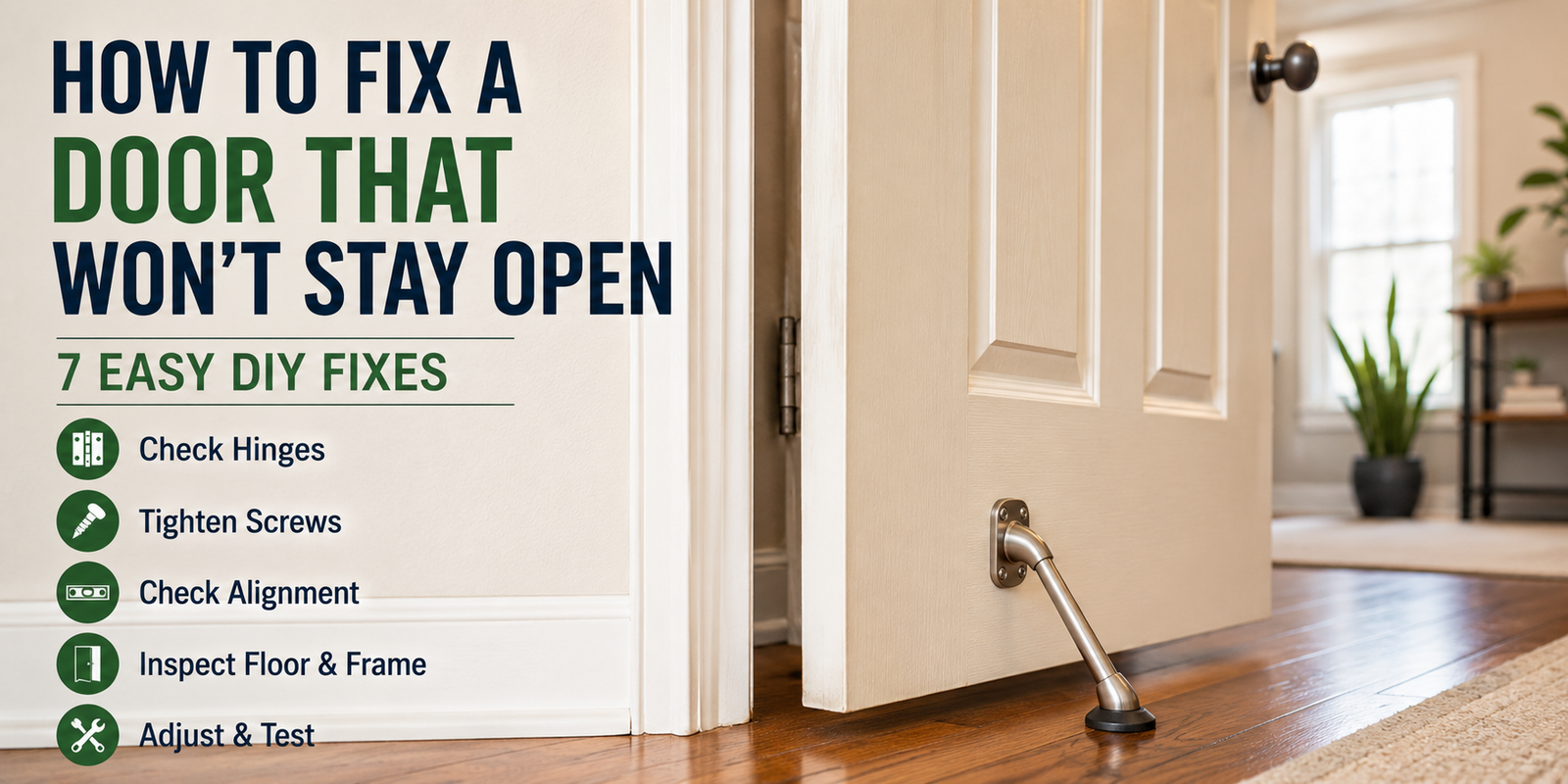
A door that refuses to stay open can be surprisingly annoying.
You open it to carry something through the room, let go of the handle, and it slowly swings shut again. Sometimes it moves only a few inches. Other times it closes almost completely, as if someone gave it a gentle push.
The good news is that the door itself is usually not the problem.
In many cases, the issue comes down to the hinges, the frame, the floor, or the way the door has settled over time. Before replacing anything, there are a few simple things worth checking.
Quick Answer
To fix a door that won’t stay open, first check whether the hinges are loose or misaligned. A door that swings shut on its own is often slightly out of alignment, although an uneven floor or shifted frame can also cause it.
Start by tightening the hinge screws and checking the hinge position. If that doesn’t solve it, inspect the door frame and floor for signs that the opening is not perfectly level. Make small adjustments and test the door after each one rather than changing several things at once.
Why Won’t My Door Stay Open?
If the door is also scraping or catching against the frame, it is worth checking the exact contact point before adjusting the hinges. Our guide on How to Fix a Door That Rubs covers the common causes and explains when adjustment or light sanding is appropriate.
A door normally stays where you leave it because the hinges, frame and floor are aligned properly.
When one of those relationships changes, gravity can take over.
Common causes include:
- Loose hinge screws
- Misaligned hinges
- A door frame that is slightly out of square
- An uneven floor
- A door that has shifted or sagged
- Hinge pins that are creating too much or too little resistance
- Previous repairs that changed the door’s alignment
The important thing is to work out which part is causing the movement before trying to fix it.
1. Check the Hinge Screws First
Loose hinges are one of the first things worth checking because even a small amount of movement can affect how a door hangs. This Old House also recommends checking loose hinge screws and alignment when diagnosing door movement.
This is where I would start because it takes almost no time.
Open the door and look closely at each hinge. Check whether any screws are visibly loose or whether the hinge plate appears to be pulling away from the wood.
A hinge does not have to be dramatically loose to affect the way a door moves. Even a small amount of movement can change the position of the door inside the frame.
Tighten the screws carefully using the correct screwdriver.
Don’t just keep turning once the screw is properly seated. Over-tightening can damage the wood around the screw hole, particularly on older doors.
Test the door
Open the door halfway and let go.
If it stays where you leave it, you may have solved the problem.
If it still swings shut, move on to the next check rather than immediately adjusting every hinge.
2. Look at the Hinge Alignment
If the screws are tight but the door still moves by itself, inspect the hinges more closely.
The hinge plates should sit firmly and evenly against the door and frame.
A hinge that has shifted slightly can change the angle of the door. That small change may be enough for the door to swing toward the closed position.
This is also why simply sanding the door is not always a good first solution.
You may be able to remove the rubbing or clearance problem, but the door can still swing shut because the underlying alignment has not been corrected.
If you notice that the hinges themselves have moved, make small adjustments and test the door after each change.
3. Check Whether the Door Is Sagging
A sagging door can also start rubbing against the frame or become difficult to close. If your door is showing several of these symptoms at once, our guide on How to Fix a Door That Sticks can help you diagnose the problem before making any permanent changes.
Stand back and look at the door from a short distance.
Does the gap around the door look reasonably even?
If the gap becomes noticeably smaller at one corner, the door may have dropped slightly.
A sagging door can behave differently from one that is correctly aligned. It may rub against the frame, make the latch harder to operate, or refuse to remain in an open position.
If you are seeing several of these symptoms together, it is worth checking your door hinge adjustment before doing anything more drastic.
A small hinge adjustment can sometimes correct the position without removing the door.
4. Test the Door at Different Opening Angles
This is a simple test, but it can tell you quite a lot.
Open the door only a few inches and let go.
Then open it halfway and test it again.
Finally, open it wider and release it.
Pay attention to what happens.
If the door always moves toward the same position, there is probably an alignment issue influencing its movement.
If it behaves differently at different points, the hinge or frame may be creating a change in resistance as the door travels.
This test takes less than a minute and can save you from making unnecessary adjustments.
5. Check the Floor
Sometimes the door gets blamed when the real problem is underneath it.
If the floor slopes slightly toward the closed position, gravity will naturally encourage the door to swing that way.
This can happen in older homes, after flooring has been replaced, or where the floor and doorway were never perfectly level to begin with.
You don’t need specialist equipment for an initial check.
Place a small level on the floor near the doorway and compare the direction of the slope with the direction the door wants to move.
If the floor clearly slopes toward the closed position, adjusting the hinges may not completely solve the problem.
Don’t try to fix a floor problem by damaging the door
This is an important distinction.
If the floor is causing the movement, removing wood from the door edge will not correct the underlying cause.
6. Inspect the Door Frame
A door frame can move slightly over the years.
Changes in the surrounding wall, previous repairs, moisture, or normal building movement can all affect the alignment.
Look at the frame from above and from the side if you can.
You are looking for obvious signs such as:
- Uneven gaps around the door
- A frame that appears twisted
- Cracks around the trim
- A door that suddenly changed behaviour
- Areas where the door sits tightly against one side of the frame
If the frame is significantly out of square, this may be beyond a simple hinge adjustment.
For a minor alignment problem, however, hinge adjustment may still be enough.
7. Check the Hinge Pins
Hinge pins can also influence how freely a door moves.
If a hinge is unusually stiff, damaged, or has been disturbed during previous work, it may not move as smoothly as the others.
With the door open, inspect the hinge barrels and pins for obvious damage or unusual movement.
Don’t start removing hinge pins without a reason.
If the hinges appear sound and the door is still swinging, return to the alignment checks rather than taking the whole hinge apart.
Sometimes the simplest explanation is still the correct one.
What If the Door Swings Shut Very Slowly?
A slow swing is usually easier to diagnose than a door that suddenly slams closed.
Open the door about halfway and release it.
If it slowly moves toward the frame every time, check the hinges and floor alignment first.
You may be dealing with a very small change in the door’s position rather than a major defect.
Make one adjustment, test it, and then decide whether another change is necessary.
What If the Door Slams Shut?
A door that moves quickly toward the closed position deserves a little more attention.
Check the hinges first.
Then look at the floor and frame.
If the movement is strong enough that the door is hitting the frame or damaging the latch, don’t keep forcing the door through repeated tests.
There may be a larger alignment problem that needs proper inspection.
A Simple Hinge Adjustment Test
If you suspect the hinges, don’t immediately remove them.
Start by marking their current position with a pencil.
Then make one small adjustment and close the door.
Open it again and test whether it stays in position.
If the change made things worse, return to the original position and try a different adjustment.
This is slower than making several changes at once, but it gives you something valuable: you know what actually changed the behaviour of the door.
Common Mistakes to Avoid
Tightening every screw as hard as possible
More force does not always mean a better repair.
Over-tightening can damage the wood and make future hinge repairs harder.
Sanding the door immediately
If the door isn’t rubbing, there may be no reason to remove any material.
Find the alignment problem first.
Adjusting all the hinges at once
Change one thing at a time.
Otherwise, you may fix one problem while creating another and have no idea which adjustment caused it.
Ignoring the floor
A small floor slope can be enough to make a door move on its own.
Assuming the frame is perfectly square
Older doorways are not always as precise as they look.
If the door has suddenly started behaving differently, inspect the frame rather than assuming nothing around it has changed.
When Is It Time to Call a Professional?
A door that won’t stay open is usually a manageable DIY problem, but not every case should be treated as a simple hinge adjustment.
Consider getting professional help if:
- The door frame is visibly damaged.
- The surrounding wall has moved or cracked.
- Several doors in the same area have developed alignment problems.
- The door is part of an exterior or security system.
- The hinges or frame are badly damaged.
- You cannot identify why the door has suddenly moved.
- The door is binding badly or cannot be closed safely.
The more widespread the movement is, the less likely it is to be just a loose screw.
Quick Troubleshooting Table
| What you notice | Likely cause | First thing to check |
|---|---|---|
| Door slowly swings shut | Alignment or floor slope | Hinges and floor |
| Door moves quickly toward frame | Significant alignment issue | Hinges and frame |
| Door also rubs at the top | Door sagging | Hinge screws |
| Door changed suddenly | Loose hinge or frame movement | Hinges |
| Door stays open only at certain angles | Alignment or floor slope | Floor and hinges |
| Frame looks uneven | Frame movement | Door opening |
| Door has been repaired before | Previous alignment change | Hinges and frame |
Final Thoughts
A door that won’t stay open is rarely a reason to replace the door.
Start with the simplest checks: hinges, alignment, floor and frame.
Don’t sand the door just because it moves. Don’t adjust every hinge at once. And don’t keep tightening screws once they are already secure.
The best DIY repairs are often the least dramatic ones. Find the small thing that changed, correct it, and then test the door again.
If the door stays where you leave it after the adjustment, you’re done.